
Friday, May 30, 2014
Why a $1 Million Goal for Retirement Still Matters

Now the Winklevoss Bitcoin ETF Needs a Clever Ticker
With the Winklevoss Bitcoin ETF, more formally known as the Winklevoss Bitcoin Trust, on track for approval before the end of the year, and an exchange already selected (the Nasdaq), we're waiting on just one more big piece of news: the ticker symbol.

The Winklevoss twins, Cameron and Tyler, filed with the U.S. Securities and Exchange Commission (SEC) for approval of their Bitcoin exchange-traded fund last July.
The twins, best known for successfully suing Facebook Inc. (Nasdaq: FB) founder Mark Zuckerberg for $140 million for stealing their idea for a social network, say the Winklevoss Bitcoin ETF would function much like the popular SPDR Gold Trust ETF (NYSE Arca: GLD).
To duplicate that structure, the Winklevoss Bitcoin ETF will buy one bitcoin for every five shares of the fund. With the current Bitcoin price at about $575, one share of the Winklevoss Bitcoin Trust would today trade for $115.
But what should the ticker be?
The famous twins might be tempted to pick a vanity ticker like WINK, VOSS, or even TWIN. However, TWIN is taken and WINK exists on the London stock exchange (for Winkworth). And does anyone really want to see VOSS?
Another avenue of possibility open to the Winklevoss Bitcoin ETF is tapping into the digital currency theme with something like BIT, COIN, CRYP, or MATH. However, all of those tickers are already being used.
If the Winklevii want to play it straight, they could go for something like BTCF, combining the widely used abbreviation of Bitcoin with an "F" for fund.
But being just a bit more clever might produce better results. This is what the science says...
Why the Winklevoss Bitcoin ETF Ticker MattersThe Winklevoss Bitcoin ETF might benefit from some research a couple of Princeton University professors did a few years ago on the impact of a ticker symbol on stock prices.
They discovered that memorable, pronounceable symbols - like Yum! Brands Inc. (NYSE: YUM) and Southwest Airlines Co. (NYSE: LUV) - actually perform better in the market.
"[Our] research shows that people take mental shortcuts, even when it comes to their investments, when it would seem they would want to be most rational," Professor Daniel Oppenheimer, who co-authored the Princeton study, told Psych Central.
And while the study showed the greatest impact of a clever ticker in the first 10 days of an IPO, the effect lingers over the long term as well.
Another study by Pomona College finance professor Gary Smith found that memorable tickers earned a 23.5% return compounded annually over a 20-year period. That more than doubled the 12% return of a hypothetical index of all NYSE and Nasdaq stocks over the same period.
While the studies were done on stocks, there's no reason to think the research is not equally valid for ETFs.
After all, the whole idea behind the Winklevoss Bitcoin ETF is to create an easy way to invest in Bitcoin. The ticker needs to mesh with that philosophy as well.
And to be sure, many ETFs have clever names, such as the Pimco ETF Trust (NYSE Arca: BOND), the Market Vectors Agribusiness ETF (NYSE Arca: MOO), the Guggenheim Shipping ETF (NYSE Arca: SEA), the ProShares Ultra Australian Dollar ETF (NYSE Arca: GDAY), and the Teucrium Corn Fund (NYSE Arca: CORN).
With most of the obvious choices unavailable, the Winklevoss twins will need to think a little harder to come up with something that makes sense and will appeal to investors.
One suggestion we like is MOON, which ties into the optimistic catchphrase "to the moon" (based on a meme of an astronaut standing on the moon with a flag bearing the Bitcoin symbol), typically uttered by digital currency enthusiasts when prices are rising.
What ticker would you choose for the Winklevoss Bitcoin ETF? Let us know on Twitter @moneymorning or Facebook.
Naysayers have buried Bitcoin many times over, but adoption keeps spreading and the Bitcoin ecosystem continues to strengthen. That's just how disruptive technologies usually work. But most people - even really smart people - fail to recognize such transformative events until after it's obvious to everyone. Here are the 10 worst tech predictions of all time...
Related Articles:
Psych Central: Stock Performance Tied to Ease of Pronouncing Company's NameThursday, May 29, 2014
3 Stocks Spiking on Big Volume
DELAFIELD, Wis. (Stockpickr) -- Professional traders running mutual funds and hedge funds don't just look at a stock's price moves; they also track big changes in volume activity. Often when above-average volume moves into an equity, it precedes a large spike in volatility.
>>5 Stocks Insiders Love Right Now
Major moves in volume can signal unusual activity, such as insider buying or selling -- or buying or selling by "superinvestors."
Unusual volume can also be a major signal that hedge funds and momentum traders are piling into a stock ahead of a catalyst. These types of traders like to get in well before a large spike, so it's always a smart move to monitor unusual volume. That said, remember to combine trend and price action with unusual volume. Put them all together to help you decipher the next big trend for any stock.
>>5 Large-Cap Trades for All-Time Gains
With that in mind, let's take a look at several stocks rising on unusual volume recently.
Media General
Media General (MEG) owns and operates broadcast television stations and related Web sites and mobile news applications in the U.S. This stock closed up 5.5% to $18.36 in Wednesday's trading session.
Wednesday's Volume: 1.02 million
Three-Month Average Volume: 371,013
Volume % Change: 201%
From a technical perspective, MEG gapped up sharply higher here and broke out above some near-term overhead resistance levels at $17.50 to $17.54 with high volume. This move is now pushing shares of MEG within range of triggering another big breakout trade. That trade will hit if MEG manages to take out Wednesday's intraday high of $18.51 and then once it clears more key overhead resistance levels at $18.92 to $19.69 with high volume.
Traders should now look for long-biased trades in MEG as long as it's trending above Wednesday's low of $17.86 and then once it sustains a move or close above those breakout levels with volume that hits near or above 371,013 shares. If that breakout hits soon, then MEG will set up to re-test or possibly take out its next major overhead resistance levels at $23 to its 52-week high at $23.97.
Twitter
Twitter (TWTR) is a global platform for public self-expression and conversation in real time. This stock closed up 10.6% to $33.77 in Wednesday's trading session.
Wednesday's Volume: 60.29 million
Three-Month Average Volume: 17.65 million
Volume % Change: 241%
From a technical perspective, TWTR exploded higher here above some near-term support at $30.38 with monster upside volume. This stock recently formed a double bottom chart pattern at $29.51 to $30.38. Following that bottom, shares of TWTR have now soared higher and the stock is quickly approaching a major breakout trade. That trade will hit if TWTR manages to take out Wednesday's intraday high of $33.84 to some more key overhead resistance at $34.10 with high volume.
Traders should now look for long-biased trades in TWTR as long as it's trending above $32 or above Wednesday's low of $31.09 and then once it sustains a move or close above those breakout levels with volume that hits near or above 17.65 million shares. If that breakout kicks off soon, then TWTR will set up to re-fill some of its previous gap-down-day zone from earlier this month that started near $40.
Workday
Workday (WDAY) provides enterprise cloud applications for global human resources and finance in the U.S. and internationally. This stock closed up 2.3% at $84.04 in Wednesday's trading session.
Wednesday's Volume: 7.89 million
Three-Month Average Volume: 2.86 million
Volume % Change: 231%
From a technical perspective, WDAY ripped modestly higher here right off its 50-day moving average of $80.13 and back above its 200-day moving average of $82.97 with strong upside volume flows. This spike higher on Wednesday also pushed shares of WDAY into breakout territory, since the stock took out some more key overhead resistance levels at $82 to $83.16. Traders should now look for a continuation move to the upside for shares of WDAY in the short-term if the stock manages to take out Wednesday's intraday high of $87.24 with strong volume.
Traders should now look for long-biased trades in WDAY as long as it's trending above its 200-day at $82.97 and then once it sustains a move or close above $87.24 with volume that hits near or above 2.86 million shares. If that move starts soon, then WDAY will set up to re-test or possibly take out its next major overhead resistance levels at $96.50 to $100, or even $105.50.
To see more stocks rising on unusual volume, check out the Stocks Rising on Unusual Volume portfolio on Stockpickr.
-- Written by Roberto Pedone in Delafield, Wis.
RELATED LINKS:
>>3 Big Stocks Getting Big Attention
>>5 Stocks Set to Soar on Bullish Earnings
>>5 Rocket Stocks to Buy for Short-Week Gains
Follow Stockpickr on Twitter and become a fan on Facebook.
At the time of publication, author had no positions in stocks mentioned.
Roberto Pedone, based out of Delafield, Wis., is an independent trader who focuses on technical analysis for small- and large-cap stocks, options, futures, commodities and currencies. Roberto studied international business at the Milwaukee School of Engineering, and he spent a year overseas studying business in Lubeck, Germany. His work has appeared on financial outlets including
CNBC.com and Forbes.com. You can follow Pedone on Twitter at www.twitter.com/zerosum24 or @zerosum24.Wednesday, May 28, 2014
Capitalize on Surging Aluminum Demand Without the Commodity Risk
Constellium (NYSE: CSTM ) is a downstream aluminum producer engaged in the design, manufacture, and sale of specialty rolled and extruded aluminum products. The Netherlands-based company, which offers its products primarily to the aerospace, automotive, and packaging industries, is a world leader in the manufacturing of high-quality aluminum products and solutions.
Aluminum demand is expected to be strong in 2014. Top U.S. aluminum producer Alcoa (NYSE: AA ) expects global demand growth of 7% and is projecting a deficit of 730,000 tons for the year. Alcoa expects the aerospace market to register the strongest growth in demand, followed by automotive.
Constellium is making investments to meet demand in these sectors. The company offers investors one of the better ways to gain exposure to these fast-growing aluminum markets without the commodity risk.
Aerospace market
With backlogs at aircraft original equipment manufacturers, or OEMs, such as Boeing (NYSE: BA ) and Airbus (NASDAQOTH: EADSY ) at all-time highs, and with aluminum taking share on aircraft design, Constellium remains confident about the future of its aircraft business. Moreover, with 90% of this business under long-term contract, Constellium has a fair degree of insulation from economic uncertainty.

Source: Company documents.
Robust demand for both large commercial aircraft and regional jets, along with continued growth in the business jet market, is driving strong aluminum demand in the aerospace sector. Constellium is the market leader in aerospace plate worldwide and is looking to continue to take share.
Constellium expects total airplane deliveries to grow at a compound annual growth rate of 8% from 2012-2017. The company remains confident that its high-margin Airware technology will help it grow market share. Compared to traditional solutions, Airware generates higher EBITDA per ton and commands longer contracts with aircraft OEMs. The Dutch company argues that its technology is several years ahead of competitive offerings.
Airware has already taken share from aluminum on current aircraft production, as demonstrated by the increase in contracted business for the product over the past 12 months. While the company is investing in capacity to meet contracted need, the demand could grow further over time.
Airware is gaining contractors' attention due to its relatively lower density/weight advantage of 5% and superior corrosion resistance compared to traditional aluminum. Over the longer term, a redesign of planes using Airware could achieve weight savings of 25%. This is a significant opportunity for Constellium, as Airware is a higher-margin product, and the company is investing 70 million euros in casting capacity.

Source: Company Documents.
Automotive market
Constellium is also positioned to benefit from growing aluminum demand in the automotive market. The company forecasts the global aluminum body-in-white, or BIW, market to grow at 45% CAGR from 2012-2015 and 14% CAGR from 2015-2020.
Constellium expects the aluminum body structure market to grow at 10% per annum from 2015-2020, and the aluminum crash management system, or CMS, market to grow at 5% per annum over the same period. Automotive will be the fastest-growing market for Constellium, rising at 18% over the medium term.

Source: Company Documents.
The company is already investing to expand capacity and meet additional demand, including 200 million euros in Europe and additional capital in the U.S. to expand BIW capacity. To supply BIW sheet in North America, Constellium has entered into a joint venture with Japan's UACJ to build a BIW mill at Bowling Green, Ky., for a combined cost of $150 million. The facility will have an initial target capacity of 100,000 tons.

Source: Company Documents.
Packaging market
While the company's packaging business is not as exciting as aerospace and automotive, it remains an important base load and a generator of free cash flow even through economic ups and downs. Constellium has no plans to exit the business, despite its relatively lower margins.

Source: Company Documents.
Moreover, there are still significant growth opportunities in the international markets, particularly Europe. Unlike the U.S., many parts of the world are still meaningfully transitioning toward a purely aluminum can market. Constellium forecasts the European beverage market transitioning from roughly 78% aluminum today to 85% in 2016. The company currently has a 36% market share; it is well positioned to leverage a projected European can stock consumption increase to 955,000 tons in 2017 from 866,000 tons in 2012.

Source: Company Documents.
Foolish wrap-up
Constellium offers investors exposure to growing aerospace and automotive markets without the commodity risk. The company remains strongly positioned to benefit from growing aluminum demand in these markets and increased market penetration of its Airware product. While the packaging segment provides earnings visibility, it also has growth opportunities in the international markets, particularly Europe.
BofA-Merrill Settles Gender Discrimination Suit for $39M
Less than a week after Bank of America-Merrill Lynch (BAC) settled a lawsuit with some 700 black brokers to the tune of $160 million, the wirehouse has agree to pay $39 million to resolve a lawsuit filed in Brooklyn, N.Y., involving about 4,800 female advisors who work or have worked previously for the firm.
“We are pleased to resolve this matter, which was filed in 2007 before Merrill Lynch was acquired by Bank of America,” the bank said Friday in a statement. “The resolution includes a number of additional and enhanced initiatives that will enrich our existing diversity, inclusion and development programs, providing even more opportunities for women to succeed as financial advisors.”
In the lawsuit, the advisors charged Bank of America-Merrill Lynch with gender discrimination tied to certain policies, from account redistribution to how advisors were put into teams.
“This settlement helps ensure that Merrill Lynch is a place where women can thrive and be successful,” Cara E. Greene, a lawyer for the plaintiffs, said in a statement shared with Bloomberg “Hopefully others will follow Merrill Lynch’s example.”
As part of the settlement, the company, which made no admission of wrongdoing or liability, agreed to put in place certain measures that will be overseen by an independent monitor. These issues include team formation and partnership agreements, business generation, account distributions, manager evaluations, promotions, training and complaint processing and procedures.
In addition, an independent consultant will conduct an internal study of Bank of America’s team formation practices, according to a spokesperson. The bank says it founded the Global Wealth Investment Management Women's Exchange in 2004 with 34 members; the group now includes some 4,000 advisor and non-advisor members.
As of June 30, the number of Merrill Lynch financial advisors was 15,759, while the number of GWIM advisors was 16,989. The total headcount for client-facing financial professionals was 19,689.
---
Check out Sallie Krawcheck: Beware of Bank Stocks on ThinkAdvisor.
Tuesday, May 27, 2014
Biggest auto recalls ever
 5 most notorious auto recalls NEW YORK (CNNMoney) There's no question General Motors' 2014 recalls involve a huge number of cars. But even its largest recall this year -- of 2.6 million vehicles for a flaw connected to at least 13 deaths -- doesn't stack up to the biggest in history.
 That distinction is held by Ford Motor, which in 1980 recalled 21 million vehicles from 10 model years for a problem that caused some vehicles to slip from park into reverse.
Do you think GM cars safe?Records show Ford's solution for that problem, which investigators linked to 6,000 accidents and nearly 100 deaths, was to send drivers a warning sticker to put on the dashboard.
So far this year, General Motors (GM, Fortune 500) has recalled a total of 15.6 million vehicles worldwide. The total includes 2.6 million with an ignition switch flaw that can cause the vehicles to unexpectedly shut off and disable safety features.
The ignition switch recall is among the deadliest in recent years, and federal regulators say they believe additional fatalities will be connected to the flaw as the investigation continues.
None of its 30 recalls this year make the top 10, but GM does have four spots on the list, according to National Highway Traffic Safety Administration records:
2. Ford (F, Fortune 500) holds both the top spot and No. 2. In 1996, it recalled 7.9 million vehicles and replaced ignition switches, which could short circuit and cause a fire in the steering column.
3. General Motors' largest recall comes in at No. 3 on the NHTSA list. Investigators found over a dozen 1960s and 1970s models had faulty engine mounts that could cause the vehicle to accelerate unexpectedly. GM recalled 6.7 million cars and trucks and installed a restraining device to hold the engine in place.
4. GM's second-largest recall was for a suspension issue affecting 5.8 million vehicles from the late 1970s. The control arm, a critical part of the suspension that attaches the rear axle to the vehicle, could detach and the driver could lose control of the car.
5. In 2005, Ford recalled 4.5 million vehicles that could catch fire. It said the speed control feature could overheat, and while it prepared replacement parts, urged drivers to have the feature disconnected. Four years later, Ford issued a second speed control recall on a different batch of vehicles. That recall also totaled 4.5 million cars.
6. Toyota's unintended acceleration re! call totaled 4.4 million vehicles. It was started in 2009, but it has continued to haunt the automaker. Earlier this year, Toyota settled for $1.2 billion a federal investigation by admitting it misled investigators.

Twenty one million vehicles came off Ford production lines in the 1970s and 1980s with a safety defect.
7. In 1972, Ford recalled 4 million cars with faulty seat belts. It said the belt could detach from the buckle.
8. GM recalled just over 3.7 million early 1970s vehicles for an undercarriage design flaw. Small stones could get lodged in the steering apparatus and make it more difficult to steer the car, GM said.
9. Volkswagen and Honda each issued recalls for 3.7 million vehicles. In 1972, Volkswagen recalled 20 years of cars because a loose screw meant the windshield wipers could stop working. Honda recalled its cars in 1995 when a major seat belt manufacturer found design flaws that meant the buckle could crack.
10. In 2004, General Motors recalled more than 3.6 million trucks because cables holding the tailgate could snap. This meant someone standing or sitting on the tailgate could fall and be injured. 
Searching for the Market Boogeyman
With the stock market reaching all-time record highs (S&P 500: 1900), you would think there would be a lot of cheers, high-fiving, and back slapping. Instead, investors are ignoring the sunny, blue skies and taking off their rose-colored glasses. Rather than securely sleeping like a baby (or relaxing during a three-day weekend) with their investment accounts, people are biting their fingernails with clenched teeth, while searching for a market boogeyman in their closets or under their beds.If you don't believe me, all you have to do is pick up the paper, turn on the TV, or walk over to the office water cooler. An avalanche of scary headlines that are spooking investors include geopolitical concerns in Ukraine & Thailand, slowing housing statistics, bearish hedge fund managers (i.e., Tepper Einhorn, Cooperman), declining interest rates, and collapsing internet stocks. In other words, investors are looking for things to worry about, despite record corporate profits and stock prices. Peter Lynch, the manager of the Magellan Fund that posted +2,700% in gains from 1977-1990, put short-term stock price volatility into perspective:"You shouldn't worry about it. You should worry what are stocks going to be 10 years from now, 20 years from now, 30 years from now."Rather than focusing on immediate stock market volatility and other factors out of your control, why not prioritize your time on things you can control. What investors can control is their asset allocation and spending levels (budget), subject to their personal time horizons and risk tolerances. Circumstances always change, but if people spent half the time on investing that they devoted to planning holiday vacations, purchasing a car, or choosing a school for their child, then retirement would be a lot less stressful. After realizing 99% of all the short-term news is nonsensical noise, the next important realization is stocks are volatile securities, which frequently go down -10 to -20%. As much as amateurs and professionals say or t! hink they can profitably predict these corrections, they very rarely can. If your stomach can't handle the roller-coaster swings, then you shouldn't be investing in the stock market.Bear-markets generally coincide with recessions, and since World War II, Americans experience about two economic contractions every decade. And as I pointed out earlier in A Series of Unfortunate Events, even during the current massive bull market, a recession has not been required to suffer significant short-term losses (e.g., Flash Crash, Greece, Arab Spring, Obamacare, Cyprus, etc.). Seasoned veterans understand these volatile periods provide incredible investment opportunities. As Warren Buffett (Trades, Portfolio) states, "Be fearful when others are greedy, and be greedy when others are fearful." Fear and panic may be behind us, but skepticism is still firmly in place. Buying during current skepticism is still not a bad thing, as long as greed hasn't permeated the masses, which remains the case today.Overly emotional people that make investment decisions with their gut do more damage to their savings accounts than conservative, emotional investors who understand their emotional shortcomings. On the other hand, the problem with investing too conservatively, for those that have longer-term time horizons (10+ years), is multi-pronged. For starters, overly conservative investments made while interest rate levels hover near historical lows lead to inflationary pressures gobbling up savings accounts. Secondly, the low total returns associated with excessively conservative investments will result in a later retirement (e.g., part-time Wal-Mart greeter in your 80s), or lower quality standard of living (e.g., macaroni & cheese dinners vs. filet mignon).Most people say they understand the trade-offs of risk and return. Over the long-run, low-risk investments result in lower returns than high risk investments (i.e., bonds vs. stocks). If you look at the following chart and ask anyone what their preferred path would b! e over th! e long-run, almost everyone would select the steep, upward-sloping equity return line.
| Currently 4.00/512345 Rating: 4.0/5 (1 vote) | Voters:
Monday, May 26, 2014World stocks mostly higher on U.S. optimism
HONG KONG (AP) — World stocks mostly rose Monday on optimism about the U.S. economy, hints from China about further stimulus and hopes for greater stability in Ukraine after its elections.
Trading volumes were low, however, as U.S. and British markets were closed for holidays. Investor sentiment was boosted after the Standard & Poor's 500 on Friday finished above the 1,900 level for the first time. The gains came after the Commerce Department on Friday reported that new home sales rose 6.4% in April after falling in the previous two months. Demand for new homes has been one of the last missing pieces as the U.S. economy, the world's largest, recovers from the global financial crisis. Meanwhile, remarks by Chinese Premier Li Keqiang that suggested Beijing is preparing further mini-stimulus measures to support the economy gave a lift to Chinese shares. Li said appropriate policy tools and timely fine tuning are being prepared as the world's second biggest economy continues to face "relatively big" downward pressure, the state-run China Daily newspaper said Saturday, citing a speech Li gave on Thursday. "There seems to be a growing view among Western strategists that while Chinese authorities will keep monetary policy steady, they are starting to look at fairly targeted support for the economy," said Chris Weston, chief strategist at IG Markets in Melbourne. In Europe, Germany's DAX rose 1.3% to close at 9,892.82 and France's CAC 40 gained 0.8% to 4,526.93. Investors were cheered by the fact that the result of the national election in Ukraine was accepted by both western powers and Russia. The president-elect said he would engage in talks with Moscow and seek to ease the crisis, though new attacks were made on pro-Russian militants in the eastern part of the country. Meanwhile, results from the European Parliament elections showed parties that are against the European Union and favor stronger national borders — on issues from immigration to business �! � made huge gains. Experts say that while their advance will not affect the European Parliament significantly, as the disparate parties will have trouble creating alliances, their strong showing could push some governments to reassess their policies. Among the notable exceptions was Italy, where a strong vote for the ruling party was seen to strengthen its mandate to reform the economy. Italy's stock market jumped 3.6 percent. Earlier, in Asia, Japan's Nikkei 225 benchmark rose 1% to close at 14,602.52 as the dollar strengthened against the yen, rising briefly above 102 yen in early trading before easing to 101.93. A weaker yen means the electronics, cars and other goods made by Japan's exporting giants such as Nikon, Sony and Honda are cheaper for overseas buyers. The Shanghai Composite Index added 0.3% to close at 2,041.48 while Hong Kong's Hang Seng ended flat 22,963.18. South Korea's Kospi dipped 0.3% to 2,010.35 while Australia's S&P/ASX 200 gained 0.4% to 5,512.80. The euro rose to $1.3653 from $1.3630. In energy markets, oil prices rose. Benchmark crude for July delivery was up 44 cents to $104.18 in electronic trading on the New York Mercantile Exchange. AT&T Stock: Bad DirecTV Acquisition Won’t Hurt Dividend      Popular Posts: What NOT to Buy in a Retirement Plan401k Moves to Make this SpringReynolds American and Lorillard – A Merger to Ignore Recent Posts: AT&T Stock: Bad DirecTV Acquisition Won’t Hurt Dividend Reynolds American and Lorillard – A Merger to Ignore Is It Time to Buy Russian and Chinese Stocks? View All Posts Popular Posts: What NOT to Buy in a Retirement Plan401k Moves to Make this SpringReynolds American and Lorillard – A Merger to Ignore Recent Posts: AT&T Stock: Bad DirecTV Acquisition Won’t Hurt Dividend Reynolds American and Lorillard – A Merger to Ignore Is It Time to Buy Russian and Chinese Stocks? View All Posts By now, you've seen the news: AT&T (T) is buying pay TV rival DirecTV (DTV) for a whopping $48.5 billion in cash and stock in one of the biggest mergers in years. Including the assumption of debt, the deal comes to $67.1 billion.
Importantly for income investors who are holding AT&T stock for its juicy 5% dividend yield, the merger shouldn't have any immediate impact on the AT&T dividend. So, what's the story here? AT&T's purchase of DirecTV is very much a "me too" merger following the $45 billion union of Comcast (CMCSA) and Time Warner Cable (TWC) to form a TV and internet juggernaut. From the looks of things, it looks as if AT&T's motivation was a fear of being left behind by its larger rivals. The move will massively expand AT&T's pay TV presence; at 20 million, DirecTV has roughly four times as many TV subscribers as AT&T. Satellite operators like DirecTV and it rival, Dish Network (DISH), have been steadily gaining ground on the traditional cable companies. Collectively, though, the cable companies have over 20 million more subscribers than the satellite operators (55 million and 34 million, respectively). Bringing up the rear, telecoms AT&T and Verizon (VZ) together have about 10 million subscribers. I certainly understand AT&T's desire to move beyond its current core business lines, all of which are mature businesses or – in the case of fixed-line telephony – businesses in terminal decline. Mobile phone plans are brutally competitive on price, and smartphones – whose data plans have been a massive source of growth in recent years – are near the market saturation point in the U.S. Piling on the pressure for AT&T stock, rivals like T-Mobile (TMUS) have upended the business model by offering cheap unlimited voice, text and plans and by eliminating carrier subsidies on handsets. But pay TV? By making a massive commitments to pay TV via the DirecTV merger, AT&T stock seems to be staking its future on another mature and brutally competitive industry, and one whose future is murky at best. Last year, the number of pay TV subscribers in America fell for the first time in history, down 251,000. Growth has been stagnant for years. The vast majority of Americans already have paid TV, though many Millennials – raised on the Internet – have found they can live without it. Frankly, they can't even afford it on their current salaries. As I wrote recently, the cost of monthly cable bills have been increasing at a rate of about 6% annually, much faster than both the rate of inflation and – importantly – wage growth. The average cable bill was $86 in 2011. By 2015, it is forecast to be $123 per month. Perhaps not surprisingly, customer satisfaction with pay TV is falling. According to the American Customer Satisfaction Index (ACSI), satisfaction with pay TV fell 4.4% in the latest update. The pay TV industry sunk to an ACSI score of 65 (out of 100), making it one of the lowest scores of all 43 industries tracked by ACSI. DirecTV is a bad buy for AT&T. But most investors that buy AT&T stock aren't buying it for growth; they buy it for its rock-solid dividend. The good news is that I don't see this merger having an impact on dividends for AT&T stock. Despite the high yield of 5%, T stock's payout ratio is only 53%. And while AT&T will probably increase its debt burden by more than 50% once the deal is finalized, the increased leverage will not be enough to put AT&T at any real risk. Bottom line: The DirecTV purchase is a questionable business move, but it won't have any adverse effect on AT&T's dividend. Charles Lewis Sizemore, CFA, is the editor of Macro Trend Investor and chief investment officer of the investment firm Sizemore Capital Management. As of this writing, he did not hold a position in any of the aforementioned securities. Click here to receive his FREE weekly e-letter covering top market insights, trends, and the best stocks and ETFs to profit from today's best global value plays. Sunday, May 25, 2014AdviceIQ: How to pay for vacation
As the grass turns green and the temperatures warm up, you find yourself gazing out the windows and dreaming of a vacation escape. Before you embark on your summer adventure, be sure to consider the family budget. Without careful planning, vacation expenses can derail the household budget and create more stress than your worst day at work.
With summer vacation season soon upon us, many families have already started planning their getaways. Of course, making the transition from work to pleasure doesn't happen without some effort. Piling the kids into the car for an eight-hour drive or wading through airport security with bags in hand can be an ordeal that sours your fun. Prior to requesting time off from work and charging up the digital camera, make sure your vacation is affordable. There is no reason to incur debt or deepen your debt load just to see a national landmark or baste in the sun's rays. Families should not get discouraged if they lack room in the budget for taking that trip around the world. While the flight to Europe or Hawaii might need to be put on hold, plenty of places are left to take the kids or grandkids and enjoy time together. The initial step: Calculate the financial outlay. What's important is recognizing the budget constraints and planning a family adventure around them. That's why first you determine how much you can afford to spend. With that number in mind, you can begin looking for a vacation destination. Doing the planning in this order is the first step to stress-free traveling and managing expectations. How much will the family vacation cost? A common mistake that travelers make is to consider transportation and accommodation expenses, but overlook incidental costs. Be sure to consider snacks and meals, souvenirs, transportation once you arrive and any tours, park fees or excursions. All of these incidentals can sometimes total more than airfare and hotel costs combined. Budgeting doesn't end during the planning phase. Be sure to monitor expens! es once you arrive at your destination. Being mindful of locations visited, activities planned and where to eat can help keep you within your budget while enjoying your travels. Vacations are a wonderful way to create memories with family and friends. They are also an excellent way to unwind. Unlike many developed countries, American companies are not required to offer employees mandatory vacation time. Elsewhere, workers view their U.S. peers as workaholics. While we all work hard, incessant work can affect stress levels and health. Therefore, our bodies and spirits need opportunities to relax. If the budget stays in focus and we invest the proper planning, we can create great times and memories. MORE: Sophia Bera on the need for financial literacy MORE: Nicholas Atkeson and Andrew Houghton on the market's bearish signals MORE: Joseph A. Clark on fixed-income risks Joseph "Big Joe" Clark, CFP, is the managing partner of the Financial Enhancement Group in Indiana and is a member of the AdviceIQ Financial Advisors Network, which is a USA TODAY content partner offering financial news and commentary. Its content is produced independently of USA TODAY. Saturday, May 24, 2014Best Buy Surprises the Street with Lighter Sales, Better Margins
They don't sell roller coasters at Best Buy (BBY), but investors probably feel as if they've been riding one lately. The consumer electronics superstore chain was one of last year's biggest winners, with its stock more than tripling. This year Best Buy has been one of the market's biggest losers, shedding nearly a third of its value in 2014 after last year's 237 percent pop. The crazy white-knuckled ride that Best Buy has been on took some new turns on Thursday after reporting its fiscal first quarter results. Sales came in lighter than expected, but improving margins found Best Buy stunning analysts by posting improving profitability. Wall Street was braced for a 38 percent plunge. That turnaround that the market seemed to be cheering on last year hasn't been easy to live up to this year, but its latest quarter shows that Best Buy is excelling in milking more out of its fading business. No one expected that. Turnarounds Turn Around It's been nearly two years since Hubert Joly was brought in as Best Buy's new CEO. The company was a mess at the time. Its former CEO was ousted after having an inappropriate relationship with a fellow employee. Best Buy's co-founder was trying to take the meandering retailer private. Best Buy had searched far and wide for a new helmsman. The Frenchman had to secure a foreign work visa just to start the job. Saving a struggling bricks-and-mortar chain was never going to be easy. The "showrooming" trend was -- and is -- going strong, with more and more people checking out products at local stores before turning around and buying them for less online. The irony is rich here: Best Buy sells the smartphones that make showrooming possible. And they sell the tablets, e-readers, and portable media players that have spurred the growth of digitally delivered media, and dried up the markets for CDs, video games and DVDs. In short, Best Buy is selling the products that make Best Buy less necessary. Despite the challenge, Joly's attack plan gained traction. His five-point "Renew Blue" strategy sought to make the chain relevant again by reinvigorating the customer experience, attracting dynamic hires, cutting costs so that it could pass savings on to shoppers, and making other improvements. Investors and employees bought into Joly's vision, but customers weren't so quick to play along. Selling the Future It's easy to wonder why the stock more than tripled last year. By the time the fiscal year was through we saw Best Buy's revenue, comparable store sales, adjusted earnings, and operating margins all decline for the year. Best Buy wasn't in better shape than it was a year earlier. It was doing worse in nearly every facet of the game. Even some trends that were working for other consumer electronics retailers -- like the appliance and furniture sales that helped Conn's (CONN) and hhgregg (HGG) as housing began to boom again -- failed to make much of a difference at Best Buy. Best Buy's report on Thursday paints a mixed portrait. It predicts same-store sales will continue to decline through the next two quarters, and that's not what Wall Street wanted to hear. However, Best Buy's strong profitability during the first quarter suggests that the company may be better positioned to withstand the showrooming trend than critics originally believed. For now, investors don't have much of a choice. Buckle up the seat belt. Bring down the shoulder restraint. The roller coaster ride will continue. More from Rick Aristotle Munarriz•Amazon Prime Pulls Out More Exclusive Content to Fight Netflix •Walmart and McDonald's Earnings Prove Price Isn't Everything •Week's Winners and Losers: EBay, HP Mishandle Bad News Days of Future Past: Nasdaq Leads Stocks Higher; S&P 500 Hits Record HighIs it possible to get too much of the X-Men? From the looks of the responses to the new flick, X-Men: Days of Future Past, the answer is probably not, at least not yet. Whether its at the box office, where the film is predicted to rake in some $120 million this weekend, or with the critics–Rotten Tomatoes has 92% of the ink stained wretches giving it a positive review–everyone seems to agree: X-Men: Days of Future Past delivers the goods. In fact, I was hard pressed to find a critic who panned the film, which unites the original X-Men cast with the one from X-Men: First Class, with Wolverine sent back in time to the 1970s to avert an apocalyptic future.  Will investors be hoping for the chance to do the same thing one day? Right now, that might seem to be hard to imagine. The S&P 500, after all, gained 1.2% to 1,900.53 this week, a new record high and the first close above 1,900 in the history of the index. The Dow Jones Industrial Average, meanwhile, rose 0.7% to 16,606.27, just 109 points, or 0.7% away from a new high of its own. Even better, the Nasdaq Composite surged ahead by 2.3% to 4,185.81, retaking the leadership it had forfeited in March, while the small-company Russell 2000 gained 2.1% to 1,126.19, regaining its 200-day moving average. The Dow Jones Industrials got a boost from UnitedHealth Group (UNH), which gained 2.8% to $78.77 this week, its highest close in more than one month. UnitedHealth announced this week that it would join the Illinois health exchange. Walt Disney (DIS) advanced 3.6% to $83.32, two cents off the 52-week high reached in March. Disneyland said it would hike prices this week. The biggest movers in the S&P 500 were also the biggest movers in the Nasdaq 100 this week. Netflix (NFLX) climbed 15% to $402.35 this week, its biggest weekly gain in four months. Netflix announced that it would launch its streaming-movie service in six European countries, including France and Germany. Trip Advisor (TRIP), meanwhile, jumped 15% to $94.42, its biggest weekly gain since July 2013. Trip Advisor purchased lafourchette this week, while Italy said it was investigating the travel booking site to see if it too appropriate steps to keep fake opinions off the website. Vertex Pharmaceuticals (VRTX) popped 9.2% to $71.04 this week. The Street.com’s Adam Feuerstein predicted the Vertex’s cystic fibrosis drug would be successful in clinical trials. As you can probably tell by those gains, investors were feeling a lot better about risky stocks this week. Still, they liked their the 10-year Treasury bonds too, even if yields ticked up 0.018% percentage points this week to 2.536%, perhaps a sign that they’re buying into the notion that the Federal Reserve means it when it says it will keep interest rates lower for longer. Schwab’s Liz Ann Sonders and team warn investors not to be caught up in the rush for yield:
With the economy improving and some signs of inflation picking up we would traditionally expect yields to move higher—and we still believe that will ultimately occur. At this point, we don’t believe the bond market is signaling a serious economic problem. There are several reasons beyond just recent weak growth for lower yields, including: demographics, waning Treasury issuance thanks to the dramatic improvement in the budget deficit, central bank policies around the world, deflationary impulses from Europe, China, and Japan, and geopolitical risks. There is clearly a global search for yield as we’ve seen high yield bonds also rise in price; while demand for sovereign debt, even in some of the countries that were recently on the precipice of default, has resulted in record low yields around the globe. We urge investors to be especially mindful of the risk associated with the search for yield. Low yields can be frustrating, but capital losses due to taking on more risk than appropriate can cause real damage to financial plans. Ned Davis Research’s Ned Davis, meanwhile, reminds investors that not only is the S&P 500–it’s trading at a price-to-sales ratio of 1.66, above the 1.26 times that separated expensive from fair value– but that expensive markets have a way of underperforming over long periods of time. He explains: Dan Sullivan, the respected "chartist" says, "We learned a long time ago that over-valued markets can and often do become even more overvalued. Some of our best gains have come over periods in which majority opinion has felt the market was overvalued." I have to agree that valuations, even at extreme levels, don't tell one very much about the short-term outlook. But I do think they can tell us a lot when looking out, say, five years… …there have been 52 quarters of "high valuations" since 1954, and five years after these 52 quarters, the market was higher 22 times and lower 30 times with a median loss of -2.5%. Compare that to the 75 quarters that the market has been undervalued since 1954. Of the 75 readings, 74 of them saw the S&P 500 higher five years later, with a median gain of 65%. Just a reminder, then, as the market continues to grind its way higher: Not even super investors have the ability to go back in time. Friday, May 23, 2014Pharma rivals eye Bausch + Lomb management
ROCHESTER, N.Y. -- A seedy bum of a guy, with no good job and no prospects, asks for permission to marry your daughter.
That protective dad, arms folded across his chest, is how one of the world's largest pharmaceutical companies says it sees itself in spurning overtures from another pharma giant, the parent company of Bausch + Lomb. Valeant Pharmaceuticals International's bid to buy Allergan — whose product lineup ranges from breast implants and Botox to anti-glaucoma medication and the Refresh line of eye drops — has become a referendum on the very integrity of Valeant's business, including what's happening to B+L. Allergan's board more than rejected the offer last week, saying it undervalued what Allergan's worth: It slammed Valeant. Allergan Chairman and CEO David Pyott told Wall Street investors, "Our model works, whereas Valeant's model of cutting and slashing really doesn't work for more than a very short period of time." In turn, Valeant has rented out a Manhattan auditorium for a meeting of Allergan and Valeant shareholders on Wednesday. According to Valeant, it plans to rebut the assertions that its business model "is not sustainable, that the Bausch + Lomb portfolio is not growing, that Valeant slashes R&D and is not committed to innovation, and that it will be impossible to capture $2.7 billion of synergies without impacting top-line growth." It also plans to sweeten its offer for Allergan. Scheduled to speak and take questions are a parade of Valeant executives from various aspects of the business. Company spokeswoman Laurie Little said the intent is to go through a number of Valeant's past acquisitions and explain how that has worked out well, as well as discuss the state of the B+L business. "We would, of course, prefer to pursue the transaction under friendly terms," company spokeswoman Laurie Little said, "but we believe the value of the combined company is so compelling that the shareholders should be the ones to decide." Montreal-! based Valeant in April suddenly came out with a big offer for Allergan: $47 billion in stock and cash. The offer dwarfs the $8.7 billion B+L takeover, which was finalized in August. In a letter to Allergan employees explaining why the board shot down the Valeant offer, Pyott wrote that while Allergan has just started a new strategy that should promise big sales and earnings growth in coming years, "Valeant's business model with low organic sales growth, serial acquisitions, and cutting of R&D, sales and marketing, and overheads is not sustainable." Valeant's track record with B+L is arguably mixed. The company has moved B+L's corporate headquarters from Rochester to New Jersey and cut roughly 400 local positions. In U.S. Securities and Exchange Commission paperwork, Valeant indicated earlier this year it expects to ultimately spend upwards of $400 million on various integration costs, such as severance packages to roughly 2,500 people. That integration of B+L is expected to be done by year's end. However, B+L's R&D efforts have almost surely taken a big hit under Valeant. It spent, on average, roughly $222 million a year on R&D under its previous owner, private equity giant Warburg Pincus. This year, Valeant expects to spend $250 million R&D companywide — part of its strategy as it frequently buys new products and technologies more than develops them in-house. In a conference call earlier this month, Valeant CEO J. Michael Pearson said B+L "will serve as a model for what we hope to achieve with Allergan." Daneman also reports for the Rochester (N.Y.) Democrat and Chronicle Thursday, May 22, 2014Morning MoneyBeat: Margin Debt Takes a BreatherMorning MoneyBeat is the Journal’s pre-market primer packed with market updates, insights and must-read news links. Send us tips, suggestions and complaints: steven.russolillo@wsj.com Click here to receive this morning newsletter via email MARKET SNAP: At 5:55 a.m. ET, S&P 500 futures up 0.1%. 10-Year Treasury yield higher at 2.54%. Nymex down 12 cents at $103.95. Gold 0.5% higher at $1294.70. In Europe, FTSE 100 up 0.03%, DAX up 0.1% and CAC 40 down 0.3%. In Asia, Nikkei 225 up 2.1% and Hang Seng up 0.5%. WATCH FOR: Weekly Jobless Claims (8:30 a.m. Eastern Time): seen 310K; previously 297K. May Markit “Flash” PMI (9:45). April Existing Home Sales (10:00): seen +2.0% at 2.68M; previously -0.2% at 4.59M. April Leading Index (10:00): seen +0.5%; previously +0.8%. May Kansas City Fed Manufacturing Survey (11:00): seen 8; previously 7. Aeropostale, Best Buy(BBY), Borcade, Buckle, Dollar Tree(DLTR), GameStop(GME), Gap(GPS), Hewlett-Packard(HPQ), Marvell Tech(MRVL), Mentor Graphics(MENT), Ross Stores(ROST) and TiVo are among companies scheduled to report quarterly results. THE BREAKFAST BRIEFINGRisk taking in the stock market is showing signs of cooling. The latest example comes from the New York Stock Exchange’s April figures on margin debt, or the amount that investors borrowed against their brokerage accounts. NYSE reported margin debt dropped for a second straight month, falling to $437.2 billion. That’s down 6.1% from a record high $465.7 billion in February and the lowest level since November. Falling margin debt over the past two months coincides with a drop in many of the speculative corners of the market. The small-cap Russell 2000 briefly hit correction territory earlier this month on an intraday basis. Social media, Internet and biotech stocks have been hit hard since early March. The broad market, though, has weathered the storm. The Dow Jones Industrial Average jumped 158 points Wednesday and finished 1.1% away from its record high. "It is good to see some of the leverage coming out of the stock market as frothy areas of the market correct," says Peter Boockvar, managing director at The Lindsey Group. With margin debt, investors pledge securities—stocks or bonds—to obtain loans from their brokerage firm. The money doesn’t have to be used to just buy more investments. The funds can be used in whatever way the account holder wishes. Margin debt had risen for eight straight months until February, which at the time raised concerns that the Fed’s easy-money policies were creating a bubble-mentality among stock investors. The last two times margin debt peaked–2000 and 2007–coincided with major tops in the stock market. The question now is whether margin debt’s latest drop is a temporary pause before it takes another leg higher, or a sign of investor concern about the rally’s ability to continue marching higher. The last time margin debt suffered a sustained pullback was in the second half of 2011, when the debt ceiling and European debt crisis sent tremors through the stock market. Few expect a repeat of that. If anything, one could argue it’s better to see margin debt drop a bit from record levels as opposed to watching it soar in unabated fashion. The recent move is a sign of a healthy market, and one that could be poised for another leg higher. Morning MoneyBeat Daily Factoid: On this day in 1992, Johnny Carson hosted "The Tonight Show" for the final time, ending a 30-year career. -By Steven Russolillo; follow him on Twitter @srussolillo. STOCKS TO WATCHBest Buy is projected to report first-quarter earnings of 19 cents a share, according to a consensus survey by FactSet. Dollar Tree is forecast to post first-quarter earnings of 66 cents a share, Hewlett-Packard is expected to report earnings of 88 cents a share in the fiscal second quarter. GameStop is projected to post first-quarter earnings of 57 cents a share, while Gap is forecast to post earnings of 57 cents a share in the first quarter. MUST READS (LINKS)Russia, China Reach Major Gas Accord: “Moscow and Beijing signed a contract to supply China with hundreds of billions of dollars of Russian gas, in a long-stalled deal that could give Vladimir Putin a boost as his relations with the West have sharply soured.” Thai Military Declares a Coup: “Thailand’s army chief announced a military coup in a televised statement Thursday, just days after declaring martial law. ” Fed Officials Tussle Over Labor Market Slack: “Fed Chairwoman Janet Yellen has argued consistently in recent months that labor markets are abundant with slack that will hold inflation and wages down. But she hasn’t convinced all her colleagues.” Heard on the Street: Home Problems Hit the Fed: “Housing tops the list of things the Federal Reserve is worrying about right now. But all it may be able to do is stand back and hope the rest of the economy takes up the slack.” Gold Bug Looks to Share the Buzz: “One of the biggest believers in gold is prospecting for outside investors after seeing the value of his personal holdings slashed in the metal’s steep fall.” Despite Data Thefts, the Password Endures: “Passwords are a bane to computer and smartphone users and a security threat to companies. Yet even after eBay(EBAY) and others urge users to change them, few people are likely to heed the warning.” NY Fed to Allow Credit Suisse(CSGN.VX) to Remain a Primary Dealer: “Credit Suisse Group AG’s ability to serve as a counterparty to the Federal Reserve Bank of New York hasn’t been affected by the bank’s criminal tax-evasion settlement.” Dutch Firm to Buy Goldman Sachs(GS) NYSE Floor Trading Business: “MC Financial Markets, a Dutch high-speed trading firm, agreed on Wednesday to acquire Goldman’s rights to operate as a designated market maker in more than 600 NYSE-listed stocks.” BofA Shuts Retail Electronic Market-Making Unit: “Bank of America is abandoning an electronic market-making unit it established last year to handle orders for its retail client base.” KKR Error Raises a Question: What Cash Should Go to Investors?: “KKR has made several erroneous disclosures about its ties to an in-house consulting unit, a lapse that highlights a broader issue of private-equity firms’ duties to pass along fee income to investors.” JD.com Prices Offering Above Expectations: “Chinese online retailer JD.com’s initial public offering priced above expectations Wednesday, even as investors continue to nurse their wounds from a selloff in high-octane technology stocks.” Even in Scandinavia, a CEO Gender Gap: “Of 145 big Nordic companies, only 3% had a woman as chief executive, compared with 5% of the U.S. Fortune 500.” Signs of a Suburban Comeback: “The long tug of war between big cities and suburbs in the U.S. is tilting ever so slightly back to the land of lawns and malls. After two years of solid urban growth, more Americans are moving again to suburbs and beyond.” Wednesday, May 21, 2014Turmoil at Target: Let the Transformation BeginTarget (TGT) has gotten pounded this month after ousting its CEO, pushing out the head of its Canadian business and hiring a new chief information officer. So it would have made sense for Target’s shares to get hit again today after the retailer said it had missed analyst forecasts and lowered its guidance.  Getty Images Getty Images Nope. Target’s shares have gained 0.7% to $56.99, while competitors were mix. Wal-Mart (WMT) has dropped 0.2% to $75.52, while Macy’s (M) has ticked up 0.1% to $56.59, and Kohl’s (KSS) has advanced 0.7% to $52.70. Deutsche Bank’s Paul Trussell and Matt Siler believe that Target’s future is less about its ability to sell lots of stuff than its ability to transform itself into, well, a better retailer. They explain: …we believe the Target story going forward will be less about current retail trends and more about the ability of this big box retailer to successfully undergo a major transformation. In speaking with management, the company highlighted a focus on generating innovative ideas to improve both U.S. and Canadian operations, and speeding up the decision making process within the merchandise organization… Sure, that might mean sacrificing its ability to stay on Target, but at this point, does anyone really care? Ford bucks up price of all-new 2015 Mustang
Ford has priced its new 2015 Mustang and buyers are going to have to pony up almost 1,100 more bucks.
The starting price of the new Mustang, loaded with improvements, will be $24,425 including delivery charges, an increase of $1,090 over the current $23,335 for the cheapest current version. When the new Mustang goes on sale in the fall, the lowest priced model will come with a 3.7-liter V-6 producing more than 300 horsepower. Two other engine options will also be available. 2015 MUSTANG: Radically new, retro, too Even though the new pony car will be more expensive, Ford spokesman Brian Cotter points out it is loaded with standard features that aren't on the current Mustang. They include items like independent rear suspension, standard backup camera, steering wheel tilt and telescope and better interior materials throughout. For the moment, Cotter says Ford isn't releasing any other pricing information on the next Mustang — just the base price. To sell off current stocks of Mustang and make way for the new one, he says there are incentives of about $1,000 on the sporty car.  The redesigned 2015 Ford Mustang is to hit dealerships this fall, a few months after the pony car's 50th birthday. (Photo: Ford) Fullscreen The redesigned 2015 Ford Mustang is to hit dealerships this fall, a few months after the pony car's 50th birthday. (Photo: Ford) Fullscreen  Ford decided on evolutionary styling on the 2015 Mustang to retain loyalists, hoping the look also is adventuresome enough to draw new buyers. (Photo: Ford) Fullscreen Ford decided on evolutionary styling on the 2015 Mustang to retain loyalists, hoping the look also is adventuresome enough to draw new buyers. (Photo: Ford) Fullscreen  Dramatic suspension and chassis changes required a wider back end on the 2015 Mustang. Rear wheels are nearly 3 inches further apart and rear fenders are about 1.5 in. wider than on current car. (Photo: Ford) Fullscreen Dramatic suspension and chassis changes required a wider back end on the 2015 Mustang. Rear wheels are nearly 3 inches further apart and rear fenders are about 1.5 in. wider than on current car. (Photo: Ford) Fullscreen  The 2015 Ford Mustang's headlights are more powerful and the fog lights are relocated. (Photo: Ford) Fullscreen The 2015 Ford Mustang's headlights are more powerful and the fog lights are relocated. (Photo: Ford) Fullscreen  The design of the 2015 Ford Mustang was done at the huge Mustang studio in Dearborn, Mich., near the automaker's headquarters. That's counter to the trend of designing in California or overseas. (Photo: Ford) Fullscreen The design of the 2015 Ford Mustang was done at the huge Mustang studio in Dearborn, Mich., near the automaker's headquarters. That's counter to the trend of designing in California or overseas. (Photo: Ford) Fullscreen  The middle roof pillar -- called the B pillar -- is hidden behind the door glass for a smoother silhouette. The B pillar normally is exposed and sits between the front and rear window glass. (Photo: Ford) Fullscreen The middle roof pillar -- called the B pillar -- is hidden behind the door glass for a smoother silhouette. The B pillar normally is exposed and sits between the front and rear window glass. (Photo: Ford) Fullscreen  Roof line of the 2015 Mustang is 1.5 in. lower than on its predecessor, to help the car slip through the air easier. (Photo: Ford) Fullscreen Roof line of the 2015 Mustang is 1.5 in. lower than on its predecessor, to help the car slip through the air easier. (Photo: Ford) Fullscreen 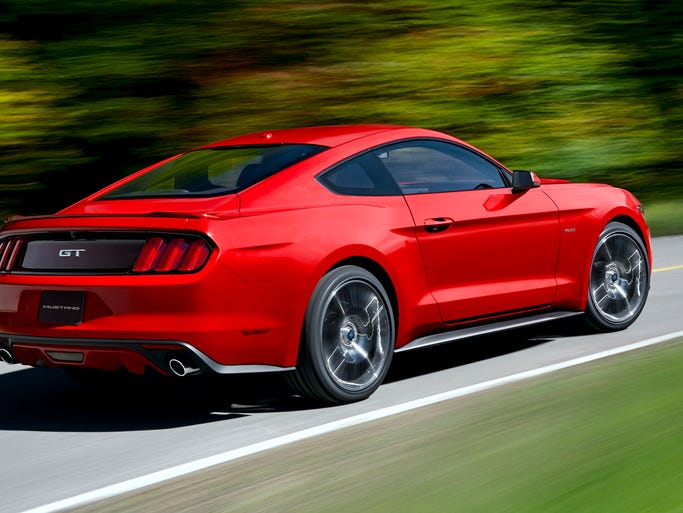 Engineers gave all versions of the 2015 Mustang an independent rear suspension. That's a first, intended to improve ride, handling and steering. It's costlier than the solid rear axle the car has used since launch April 17, 1964. (Photo: Ford) Fullscreen Engineers gave all versions of the 2015 Mustang an independent rear suspension. That's a first, intended to improve ride, handling and steering. It's costlier than the solid rear axle the car has used since launch April 17, 1964. (Photo: Ford) Fullscreen  Traditional-looking dashboard belies updated electronics. The transmission is a Getrag six-speed and the shiftier has been modified to provide what Ford says are shorter, smoother throws. (Photo: Ford) Fullscreen Traditional-looking dashboard belies updated electronics. The transmission is a Getrag six-speed and the shiftier has been modified to provide what Ford says are shorter, smoother throws. (Photo: Ford) Fullscreen  Passenger airbag is inside the glove box door to allow a sleeker dashboard on the 2015 Mustang. Middle air vent can be replaced with pair of gauges. (Photo: Ford) Fullscreen Passenger airbag is inside the glove box door to allow a sleeker dashboard on the 2015 Mustang. Middle air vent can be replaced with pair of gauges. (Photo: Ford) Fullscreen  Running horse logo remains prominent on the 2015 Mustang. (Photo: Ford) Fullscreen Running horse logo remains prominent on the 2015 Mustang. (Photo: Ford) Fullscreen  GT V-8 version of the redesigned 2015 Ford Mustang uses different-size tires front and rear to tailor handling. (Photo: Ford) Fullscreen GT V-8 version of the redesigned 2015 Ford Mustang uses different-size tires front and rear to tailor handling. (Photo: Ford) Fullscreen  Front of the 2015 Ford Mustang was designed to have a "shark-like" appearance, says Joel Piaskowski, Mustang design director. (Photo: Ford) Fullscreen Front of the 2015 Ford Mustang was designed to have a "shark-like" appearance, says Joel Piaskowski, Mustang design director. (Photo: Ford) Fullscreen  Tires have a rub strip to minimize curb rash on the expensive allow wheels, which sit flush with the body. (Photo: Ford) Fullscreen Tires have a rub strip to minimize curb rash on the expensive allow wheels, which sit flush with the body. (Photo: Ford) Fullscreen  Three-bar lights and forward slant of car's nose are part of the "shark-like" appearance of the 2015 Mustang. (Photo: Ford) Fullscreen Three-bar lights and forward slant of car's nose are part of the "shark-like" appearance of the 2015 Mustang. (Photo: Ford) Fullscreen  When operating as turn signals, the 2015's three-bar rear lights flash sequentially in the direction of the turn, a feature of early Mustangs and also used by Ford on 1960s Thunderbirds and Mercury Cougars. (Photo: Ford) Fullscreen When operating as turn signals, the 2015's three-bar rear lights flash sequentially in the direction of the turn, a feature of early Mustangs and also used by Ford on 1960s Thunderbirds and Mercury Cougars. (Photo: Ford) Fullscreen  Hood of the redesigned 2015 Ford Mustang has functional air vents rather than phony ones some cars use for a high-performance look. (Photo: Ford) Fullscreen Hood of the redesigned 2015 Ford Mustang has functional air vents rather than phony ones some cars use for a high-performance look. (Photo: Ford) Fullscreen  Wider rear to accommodate the new suspension is clearly evident on the 2015 Mustang. (Photo: Ford) Fullscreen Wider rear to accommodate the new suspension is clearly evident on the 2015 Mustang. (Photo: Ford) Fullscreen  Three engines will be offered. Base is 3.7-liter V-6 to be rated about 300 hp. Optional, and likely favored overseas, is 2.3-liter EcoBoost turbocharged four of at least 305 hp. GT gets 5-liter V-8 fo at least 420 hp. (Photo: Ford) Fullscreen Like this topic? You may also like these photo galleries:Replay Three engines will be offered. Base is 3.7-liter V-6 to be rated about 300 hp. Optional, and likely favored overseas, is 2.3-liter EcoBoost turbocharged four of at least 305 hp. GT gets 5-liter V-8 fo at least 420 hp. (Photo: Ford) Fullscreen Like this topic? You may also like these photo galleries:Replay                   AutoplayShow ThumbnailsShow CaptionsLast SlideNext Slide AutoplayShow ThumbnailsShow CaptionsLast SlideNext SlideFord also announced its first "appearance package" for the new Mustang, commemorating its 50th-anniversary edition. The package will be available for turbocharged Mustang EcoBoost Premium and hot Mustang GT Premium models. The appearance package includes a chrome-accented grille, round 50 Years rear badge, 19-inch alloy wheels with all-season tires, anniversary floor mats and unique seat and door-trim stitching, Ford said. The package has some of the elements of the limited-edition 50th anniversary Mustang, which was announced at the New York Auto Show.
Subscribe to:
Posts (Atom)
|
 Whether or not this is a good move for AT&T shareholders is debatable. AT&T is buying a mature business with limited growth potential domestically. The cash portion of the deal – $14.5 billion – will need to be largely financed by debt, as AT&T only has about $3.8 billion in cash on hand.
 Spencer Platt/Getty Images