Monday, April 1, 2019

Hold Kewal Kiran Clothing; target of Rs 1300: ICICI Direct


ICICI Direct's research report on Kewal Kiran Clothing


We met the management of Kewal Kiran Clothing to gain an insight into the company's business outlook. Kewal Kiran is one of India's leading branded apparel companies with popular home-grown brands like "Killer", 'Integriti', 'Lawman' and 'Easies'. Though KKCL has a strong brand portfolio, revenue growth has remained sluggish over FY17-9MFY19 owing to the onslaught of discounting by e-commerce players. KKCL has shied away from discounting its brands, leading to slower revenue growth. However, the management is looking to revive revenue growth by introducing lower priced products as brand extensions rather than diluting the original brand.


Outlook


KKCL has a strong balance sheet, with debt/equity ratio comfortably placed at 0.2x and having a strong cash position. We roll our estimates to FY21 and model revenue and PAT CAGR of 10% and 11%, respectively, in FY18-21E. We have a HOLD rating on the stock with a revised target price of Rs 1300 (16.0x FY21E EPS).


For all recommendations report, click here


Disclaimer: The views and investment tips expressed by investment experts/broking houses/rating agencies on moneycontrol.com are their own, and not that of the website or its management. Moneycontrol.com advises users to check with certified experts before taking any investment decisions.

Read More First Published on Mar 26, 2019 04:35 pm

Monday, March 25, 2019

Jamie Dimon says we've split the US economy, leaving the poor behind

J.P. Morgan Chase CEO Jamie Dimon said that the U.S. economy has essentially been split into those benefiting from thriving corporations and those who are left behind.

"I don't want to be a tone deaf CEO; while the company is doing fine, it is absolutely obvious that a big chunk of [people] have been left behind," Dimon said. "Forty percent of Americans make less than $15 an hour. Forty percent of Americans can't afford a $400 bill, whether it's medical or fixing their car. Fifteen percent of Americans make minimum wages, 70,000 die from opioids" annually.

"If you travel around to most neighborhoods where companies live, they're doing fine," Dimon said. "So we've kind of bifurcated the economy."

Dimon was speaking at an event at the bank's New York headquarters to unveil a new $350 million program to boost job prospects for people in under-served communities. The J.P. Morgan chairman and CEO has frequently voiced concern about the declining labor force participation rate and the shortfalls of the educational system in preparing people for emerging roles.

Making progress against these issues involves companies working with local organizations to provide skills outside of the university context, he said.

Dimon called the education system "broken" and said his bank stopped giving philanthropic dollars to colleges years ago.

"Harvard and Princeton are not a philanthropy," Dimon said. "Helping these kids is."

Sunday, March 24, 2019

Top 5 Canadian Stocks To Watch For 2019

tags:ECA,CS,PBH,VRX,UNS,

In just three months and a day, the legal cannabis landscape will change forever. On Oct. 17, 2018, recreational marijuana will become legal for adults in Canada, making it the first industrialized country in the world to have approved adult use (and the second country overall, behind Uruguay).

As you might have rightly guessed, investors are champing at the bit to get a taste of the massive growth surge that awaits -- and so are the cannabis growers responsible for supplying the Canadian recreational market. We've witnessed no shortage of capacity expansion announcements, partnerships, and acquisitions since the beginning of the year as marijuana growers angle to gobble up as much market share as possible once the proverbial green flag waves.

Image source: Getty Images.

However, this rapid capacity expansion has led to a lot of fluidity in terms of production forecasts. Every attempt to quantify how much cannabis will be produced by Canadian domestic growers each year often proves obsolete within a matter of days. But one thing is certain: There will be no shortage of major players.

Top 5 Canadian Stocks To Watch For 2019: Encana Corporation(ECA)

Advisors' Opinion:
  • [By Max Byerly]

    Shares of Encana Corp (NYSE:ECA) (TSE:ECA) gapped up before the market opened on Tuesday . The stock had previously closed at $5.95, but opened at $6.10. Encana shares last traded at $6.11, with a volume of 65113676 shares changing hands.

  • [By Matthew DiLallo]

    Canada's Montney Shale doesn't currently capture investors' attention like the Permian Basin. However, that doesn't mean it's a second-tier play. Quite the contrary since, like the Permian, it's a resource-rich region with as many as six drillable formations that produce highly economic liquids-rich natural gas. Because of those features, it has become an important growth driver for companies like Encana (NYSE:ECA).

  • [By Matthew DiLallo]

    Today, however, many drillers are setting a high bar for new wells. EOG Resources (NYSE:EOG) has been one of the leaders in disrupting the former way of thinking by establishing a high return hurdle rate for new wells of 30% after-tax at $40 oil. Others followed with similar return-focused approaches, including Encana (NYSE:ECA), which needs locations to achieve a 35% after-tax return at $50 oil to meet its premium hurdle rate. 

  • [By Shane Hupp]

    Electra (CURRENCY:ECA) traded 3.4% lower against the dollar during the 24-hour period ending at 18:00 PM Eastern on June 4th. Electra has a total market capitalization of $45.83 million and approximately $326,372.00 worth of Electra was traded on exchanges in the last 24 hours. One Electra coin can currently be bought for $0.0018 or 0.00000024 BTC on cryptocurrency exchanges including Novaexchange, Octaex, Fatbtc and Cryptopia. In the last seven days, Electra has traded 12.8% higher against the dollar.

  • [By Lee Jackson]

    This stock has pulled back sharply and is offering an outstanding entry point. Encana Corp. (NYSE: ECA) is an energy producer focused on developing its multibasin portfolio of natural gas, oil and natural gas liquids (NGLs) producing plays. Its operations also include the marketing of natural gas, oil and NGLs. All of its reserves and production are located in North America.

  • [By Ethan Ryder]

    Encana Corp (NYSE:ECA) (TSE:ECA) – National Bank Financial issued their FY2019 EPS estimates for shares of Encana in a report released on Tuesday, February 12th. National Bank Financial analyst T. Wood expects that the oil and gas company will post earnings of $0.61 per share for the year. National Bank Financial has a “Outperform” rating and a $18.50 price objective on the stock.

Top 5 Canadian Stocks To Watch For 2019: Credit Suisse Group(CS)

Advisors' Opinion:
  • [By Ethan Ryder]

    Credits (CS) is a distributed proof-of-stake (dPOS) token that uses the DPoS hashing algorithm. It was first traded on February 28th, 2015. Credits’ total supply is 249,471,071 tokens and its circulating supply is 137,958,656 tokens. Credits’ official message board is medium.com/@credits. The official website for Credits is credits.com/en. Credits’ official Twitter account is @creditscom and its Facebook page is accessible here. The Reddit community for Credits is /r/CreditsOfficial and the currency’s Github account can be viewed here.

  • [By Max Byerly]

    AXA (EPA:CS) has been given a €27.50 ($32.74) target price by research analysts at Kepler Capital Markets in a report released on Thursday. The firm presently has a “buy” rating on the stock. Kepler Capital Markets’ price target indicates a potential upside of 20.61% from the company’s current price.

  • [By Joseph Griffin]

    UBS Group set a €21.50 ($24.43) price target on AXA (EPA:CS) in a research note published on Monday morning, www.boersen-zeitung.de reports. The firm currently has a neutral rating on the stock.

Top 5 Canadian Stocks To Watch For 2019: Prestige Brand Holdings Inc.(PBH)

Advisors' Opinion:
  • [By Stephan Byrd]

    Shares of Prestige Brands Holdings, Inc. (NYSE:PBH) have been assigned a consensus recommendation of “Hold” from the ten brokerages that are presently covering the stock, MarketBeat.com reports. Three equities research analysts have rated the stock with a sell rating, two have given a hold rating and four have assigned a buy rating to the company. The average 12 month price objective among analysts that have covered the stock in the last year is $73.80.

  • [By Lisa Levin]

    On Thursday, the health care shares rose 1.02 percent. Meanwhile, top gainers in the sector included ARMO BioSciences, Inc. (NASDAQ: ARMO), up 67 percent, and Prestige Brands Holdings, Inc. (NYSE: PBH) up 28 percent.

  • [By Stephan Byrd]

    SG Americas Securities LLC increased its position in Prestige Brands (NYSE:PBH) by 103.2% during the first quarter, according to the company in its most recent 13F filing with the Securities & Exchange Commission. The firm owned 16,597 shares of the company’s stock after acquiring an additional 8,431 shares during the period. SG Americas Securities LLC’s holdings in Prestige Brands were worth $560,000 at the end of the most recent reporting period.

  • [By Joseph Griffin]

    Prestige Consumer Healthcare Inc (NYSE:PBH) – Stock analysts at William Blair cut their Q4 2019 earnings estimates for shares of Prestige Consumer Healthcare in a report released on Thursday, February 7th. William Blair analyst J. Andersen now forecasts that the company will post earnings of $0.69 per share for the quarter, down from their previous forecast of $0.70. William Blair also issued estimates for Prestige Consumer Healthcare’s FY2020 earnings at $2.80 EPS.

Top 5 Canadian Stocks To Watch For 2019: Valeant Pharmaceuticals International Inc(VRX)

Advisors' Opinion:
  • [By Chris Lange]

    When Valeant Pharmaceuticals International Inc. (NYSE: VRX) reported its most recent quarterly results before the markets opened on Wednesday, the company said that it had $0.98 in earnings per share (EPS) on $2.16 billion in revenue. That compares with consensus estimates from Thomson Reuters that called for $0.97 per share and $2.18 billion. The fourth quarter of last year reportedly had EPS of $1.26 and $2.4 billion in revenue.

  • [By Chris Lange]

    Valeant Pharmaceuticals International Inc. (NYSE: VRX) has a PDUFA date set for May 13. Specifically, this is for its New Drug Application for Plenvu (NER1006), which was licensed by Salix from Norgine in August 2016 for introduction to the U.S. market. Plenvu is a next-generation bowel cleansing preparation for colonoscopies.

  • [By Keith Speights]

    Believe it or not, one of the best-performing healthcare stocks so far this year is none other than Valeant Pharmaceuticals International (NYSE:VRX). Longtime loser Valeant is up around 20% year to date -- much better than most healthcare stocks.

Top 5 Canadian Stocks To Watch For 2019: UniSource Energy Corporation(UNS)

Advisors' Opinion:
  • [By Ethan Ryder]

    Uni Select (TSE:UNS) had its price target lifted by investment analysts at Macquarie from C$24.00 to C$25.00 in a report released on Wednesday. Macquarie’s price objective suggests a potential upside of 18.32% from the stock’s current price.

  • [By Max Byerly]

    Uni Select (TSE:UNS)‘s stock had its “hold” rating restated by equities research analysts at TD Securities in a report issued on Friday. They currently have a C$24.00 price objective on the stock. TD Securities’ price target points to a potential upside of 8.21% from the stock’s current price.

Friday, March 22, 2019

Don't be lured by Facebook's lower stock price, portfolio manager warns

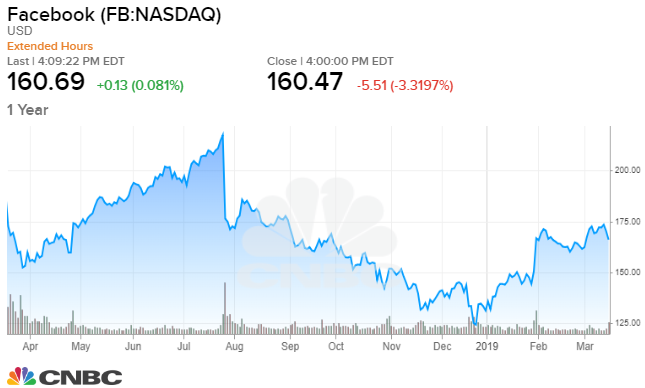
Facebook stock is now about 27 percent lower than its July all-time high, and Street sentiment — as measured by the number of hold and sell ratings — is the most bearish it's been since 2013, based on FactSet estimates.

While growing skepticism can sometimes be a good contrarian indicator, Strategic Wealth Partners' Mark Tepper says to stay away from the stock, saying its ad revenue is facing a hit.

"I mean it's trading at a significant discount to the S&P, but in my opinion it's for good reason," Tepper said Monday on CNBC's "Trading Nation." "They've just got an absolute ton of headwinds, like privacy, government regulation, key employee turnover. But my main concern with them is their digital advertising platform."

Earlier Monday, Needham downgraded the stock to hold,citing issues including management turnover and a tougher regulatory environment. Over the last few weeks the company has announced several key changes, including high-profile executive departures and a plan for greater privacy.

Teppers said Facebook was a valuable advertising platform because "they knew so much about their users and could really zero in on their ideal customers. But all that changed. Demographics are gone and their platform has been diluted."

He said Alphabet is a better stock to own since the company still provides highly targeted ads that are more valuable to advertisers.

"With Google, ads are being shown to people who are actually searching for something. So that makes those ads more relevant. And for advertisers, the cost per click might be lower on Facebook, but the advertisers will very quickly learn that what really matters most is their cost per new customer, and that's going to be better on Google, so I prefer Google here," he said.

Over the last year, shares of Facebook have slid about 13 percent, while Alphabet has gained nearly 5 percent.

Disclosure: Strategic Wealth Partners owns shares of Facebook and Alphabet.

Disclaimer

Wednesday, March 20, 2019

Hot Penny Stocks To Buy For 2019

tags:CPHI,SORL,CNR,TIS,

The U.S. Energy Information Administration (EIA) reported Thursday morning that U.S. natural gas stockpiles increased by 69 billion cubic feet for the week ending August 31.

Analysts were expecting a storage injection of around 65 billion cubic feet. The five-year average for the week is an injection of 74 billion cubic feet, and last year’s storage increase for the week totaled 87 billion cubic feet. Natural gas inventories rose by 63 billion cubic feet in the week ending August 31.

Natural gas futures for October delivery traded up about a penny in advance of the EIA’s report, at around $2.83 per million BTUs, and it rose to about $2.85 shortly after the report was released.

For the period between September 13 and September 19, NatGasWeather.com predicts “moderate” demand and offers the following outlook:

Hurricane Florence will track inland along the N. & S. Carolina Coasts in the coming days with flooding rains and dangerous winds, then moving inland over the Southeast this weekend. Texas and the South will see areas of showers, while a cooler system impacts the Northwest. It remains hot over the Southwest with 90s and 100s, while also hot over the Southeast with lower 90s. Warm high pressure will strengthen over the northern half of the country to close out the week with 80s becoming widespread besides the Northwest.

Hot Penny Stocks To Buy For 2019: China Pharma Holdings Inc.(CPHI)

Advisors' Opinion:
  • [By Logan Wallace]

    These are some of the news headlines that may have impacted Accern Sentiment’s scoring:

    Get Scynexis alerts: Steady Activities: SCYNEXIS, Inc. (NASDAQ:SCYX), LPL Financial Holdings Inc. (NASDAQ:LPLA) (oracleexaminer.com) Do Analysts Think You Should Buy – SCYNEXIS Inc (NASDAQ: SCYX) (stockspen.com) Notable Runner: SCYNEXIS, Inc. (SCYX) (nasdaqplace.com) Most Active Stocks Now: SCYNEXIS, Inc. (NASDAQ:SCYX), China Pharma Holdings, Inc. (NYSE:CPHI), Kala … (journalfinance.net) Overview on price to free cash flow: SCYNEXIS, Inc. (NASDAQ:SCYX), InfuSystem Holdings Inc. (NYSE:INFU) (stocksnewspoint.com)

    Several research analysts have recently issued reports on the company. Roth Capital assumed coverage on Scynexis in a research note on Tuesday, May 8th. They set a “buy” rating and a $6.00 price target for the company. Seaport Global Securities assumed coverage on Scynexis in a research note on Tuesday, April 10th. They set a “buy” rating and a $4.00 price target for the company. Zacks Investment Research raised Scynexis from a “hold” rating to a “buy” rating and set a $1.25 price target for the company in a research note on Tuesday, May 8th. HC Wainwright assumed coverage on Scynexis in a research note on Monday, May 7th. They set a “buy” rating and a $5.00 price target for the company. Finally, ValuEngine raised Scynexis from a “sell” rating to a “hold” rating in a research note on Wednesday, May 2nd. One research analyst has rated the stock with a hold rating and six have assigned a buy rating to the stock. Scynexis currently has an average rating of “Buy” and an average target price of $4.45.

Hot Penny Stocks To Buy For 2019: SORL Auto Parts Inc.(SORL)

Advisors' Opinion:
  • [By Lisa Levin] Gainers Euro Tech Holdings Company Limited (NASDAQ: CLWT) shares rose 14.1 percent to $3.65 in the pre-market trading session after reporting 2017 year-end results. LightPath Technologies, Inc. (NASDAQ: LPTH) rose 13.3 percent to $2.43 in pre-market trading after reporting a third-quarter earnings beat. MYnd Analytics, Inc. (NASDAQ: MYND) rose 10.5 percent to $3.49 in pre-market trading. MYnd Analytics reported a Q2 net loss of $2.7 million on revenue of $459,900. SORL Auto Parts, Inc. (NASDAQ: SORL) shares rose 8.4 percent to $5.68 in pre-market trading after reporting upbeat Q1 results. Famous Dave's of America, Inc. (NASDAQ: DAVE) shares rose 7.7 percent to $8.40 in pre-market trading after the company reported upbeat earnings for its first quarter on Monday. Xenon Pharmaceuticals Inc. (NASDAQ: XENE) rose 7.5 percent to $6.45 in pre-market trading after the company presented XEN901 Phase 1 clinical update and XEN1101 TMS pharmacodynamic Phase 1 data. Mimecast Ltd (NASDAQ: MIME) rose 6.5 percent to $43.50 in pre-market trading following a first-quarter sales beat. Boxlight Corporation (NASDAQ: BOXL) rose 6 percent to $12.50 in pre-market trading after surging 77.44 percent on Monday. Intellia Therapeutics, Inc. (NASDAQ: NTLA) shares rose 6 percent to $26.05 in pre-market trading after climbing 3.58 percent on Monday. PPDAI Group Inc. (NASDAQ: PPDF) rose 4.7 percent to $7.20 in pre-market trading following Q1 results. Xunlei Limited (NASDAQ: XNET) rose 4.1 percent to $13.88 in pre-market trading after gaining 2.54 percent on Monday. Valeant Pharmaceuticals International, Inc. (NYSE: VRX) shares rose 4.5 percent to $21.73 in pre-market trading. Mizuho upgraded Valeant from Neutral to Buy. Bovie Medical Corporation (NYSE: BVX) rose 4.1 percent to $3.80 in pre-market trading after reporting a first-quarter sales beat. Myomo, Inc. (NYSE: MYO) rose 3.4 percent to $4.00 in pre-market trading after jumping 23.25 percent o
  • [By Logan Wallace]

    News coverage about Sorl Auto Parts (NASDAQ:SORL) has trended somewhat positive recently, Accern reports. The research firm identifies negative and positive press coverage by analyzing more than twenty million blog and news sources. Accern ranks coverage of public companies on a scale of negative one to positive one, with scores closest to one being the most favorable. Sorl Auto Parts earned a coverage optimism score of 0.12 on Accern’s scale. Accern also gave press coverage about the company an impact score of 48.4932889103567 out of 100, meaning that recent press coverage is somewhat unlikely to have an impact on the stock’s share price in the next few days.

  • [By Lisa Levin] Gainers Euro Tech Holdings Company Limited (NASDAQ: CLWT) shares climbed 70.3 percent to $5.45 after reporting 2017 year-end results. MEDIGUS Ltd/S ADR (NASDAQ: MDGS) surged 39.8 percent to $1.58 in reaction to its Monday announcement of a distribution agreement. The medical device company said it reached an agreement to distribute its minimally invasive medical devices in Turkey, Azerbaijan and Georgia. Arcadia Biosciences, Inc. (NASDAQ: RKDA) gained 25.6 percent to $11.50. Arcadia Biosciences reported that Albert D. Bolles, Ph.D. has joined its board of directors. Aytu Bioscience Inc (NASDAQ: AYTU) shares jumped 21.8 percent to $0.4798 after the company late Monday reported lighter-than-expected Q1 loss. Hollysys Automation Technologies Ltd. (NASDAQ: HOLI) shares gained 21.1 percent to $26.77 following Q3 results. Pfenex Inc. (NYSE: PFNX) rose 16.8 percent to $7.1271 after the company announced the positive top-line PF708 study results in Osteoporosis patients that showed no imbalances in severity or incidence of adverse events. MEI Pharma, Inc. (NASDAQ: MEIP) rose 13.8 percent to $2.88. Red Violet, Inc. (NASDAQ: RDVT) jumped 13.1 percent to $6.41 after reporting Q1 results. SORL Auto Parts, Inc. (NASDAQ: SORL) shares gained 12 percent to $5.87 after reporting upbeat Q1 results. Bovie Medical Corporation (NYSE: BVX) gained 8.4 percent to $3.96 after reporting a first-quarter sales beat. Rosehill Resources Inc. (NASDAQ: ROSE) surged 8.4 percent to $7.90 after announcing Q1 results. LiqTech International, Inc. (NASDAQ: LIQT) rose 8.1 percent to $0.5171 following Q1 results. ProPhase Labs, Inc. (NASDAQ: PRPH) rose 7.7 percent to $5.6103 following Q1 results. Nine Energy Service, Inc. (NYSE: NINE) shares climbed 7.4 percent to $35.90. Xenon Pharmaceuticals Inc. (NASDAQ: XENE) rose 6.7 percent to $6.40 after the company presented XEN901 Phase 1 clinical update and XEN1101 TMS pharmacodynamic Phase 1 data. MYnd
  • [By Max Byerly]

    These are some of the news articles that may have impacted Accern Sentiment Analysis’s analysis:

    Get Innovative Industrial Properties alerts: Return on Equity (ROE) under Consideration Innovative Industrial Properties, Inc. (NYSE:IIPR), Neonode Inc … (stocksnewspoint.com) Morning Miraculous Stocks: Taseko Mines Limited (NYSE:TGB), WMIH Corp. (NASDAQ:WMIH), Innovative Industrial … (journalfinance.net) Dazzling Stocks: Innovative Industrial Properties, Inc. (NYSE:IIPR), SORL Auto Parts, Inc. (NASDAQ:SORL), ReWalk … (thestreetpoint.com) Head-To-Head Contrast: Kennedy-Wilson (KW) vs. Innovative Industrial Properties (IIPR) (americanbankingnews.com) Innovative Industrial (IIPR) versus Colliers International Group (CIGI) Financial Contrast (americanbankingnews.com)

    A number of research analysts have weighed in on the company. Zacks Investment Research raised Innovative Industrial Properties from a “sell” rating to a “hold” rating in a report on Friday, March 16th. ValuEngine raised Innovative Industrial Properties from a “hold” rating to a “buy” rating in a report on Wednesday, May 2nd.

Hot Penny Stocks To Buy For 2019: China Metro-Rural Holdings Limited(CNR)

Advisors' Opinion:
  • [By Max Byerly]

    Press coverage about Canadian National Railway (NYSE:CNI) (TSE:CNR) has been trending somewhat positive on Thursday, according to Accern Sentiment Analysis. Accern identifies positive and negative press coverage by monitoring more than twenty million blog and news sources. Accern ranks coverage of public companies on a scale of negative one to one, with scores closest to one being the most favorable. Canadian National Railway earned a coverage optimism score of 0.15 on Accern’s scale. Accern also gave media coverage about the transportation company an impact score of 47.5112066080017 out of 100, meaning that recent press coverage is somewhat unlikely to have an impact on the company’s share price in the immediate future.

  • [By Ethan Ryder]

    State of Tennessee Treasury Department lessened its stake in shares of Canadian National Railway (NYSE:CNI) (TSE:CNR) by 1.6% in the 1st quarter, according to the company in its most recent 13F filing with the SEC. The institutional investor owned 842,775 shares of the transportation company’s stock after selling 13,507 shares during the quarter. State of Tennessee Treasury Department owned about 0.11% of Canadian National Railway worth $61,565,000 as of its most recent filing with the SEC.

  • [By Logan Wallace]

    Canadian National Railway (NYSE:CNI) (TSE:CNR) – Analysts at Seaport Global Securities issued their Q1 2019 EPS estimates for shares of Canadian National Railway in a research note issued to investors on Wednesday, January 30th. Seaport Global Securities analyst M. Levin expects that the transportation company will earn $0.96 per share for the quarter. Seaport Global Securities also issued estimates for Canadian National Railway’s Q2 2019 earnings at $1.26 EPS, Q3 2019 earnings at $1.27 EPS and Q4 2019 earnings at $1.26 EPS.

Hot Penny Stocks To Buy For 2019: Orchids Paper Products Company(TIS)

Advisors' Opinion:
  • [By Money Morning Staff Reports]

    After looking at last week's top-performing penny stocks, we'll show you a penny stock on the verge of jumping over 159%…

    Penny Stock Current Share Price Last Week's Gain My Size Inc. (NASDAQ: MYSZ) $1.19 60.71% Delcath Systems Inc. (OTCMKTS: DCTH) $3.21 52.38% Regional Health Properties Inc. (NYSE: RHE) $0.18 49.39% Nemaura Medical Inc. (NASDAQ: NMRD) $3.03 44.89% 3Pea International Inc. (NASDAQ: TPNL) $4.62 42.24% PLx Pharma Inc. (NASDAQ: PLXP) $4.22 34.38% Orchids Paper Products Co. (NYSE: TIS) $3.99 34.30% DelMar Pharmaceuticals Inc. (NASDAQ: DMPI) $0.74 33.41% Restoration Robotics Inc. (NASDAQ: HAIR) $3.08 32.74% Renren Inc. (NYSE: RENN) $1.69 32.61%

    Don't Miss Out: The Treasury is sitting on an $11.1 billion cash pile, and a loophole entitles Americans to a sizable portion. Some are collecting $1,795, $3,000, or $5,000 every month thanks to this powerful investment…

  • [By Lisa Levin] Gainers SemiLEDs Corporation (NASDAQ: LEDS) shares rose 35.8 percent to $4.55. EVINE Live Inc. (NASDAQ: EVLV) gained 28.8 percent to $1.04. The pay-TV home shopping company was named as a potential acquisition target by TechCrunch. According to the publication, Amazon.com, Inc. (NASDAQ: AMZN) is exploring ways of marketing its products and services to consumers beyond the internet. Sanmina Corp (NASDAQ: SANM) shares surged 19.1 percent to $33.00 as the company reported stronger-than-expected earnings for its second quarter on Monday. Heidrick & Struggles International, Inc. (NASDAQ: HSII) gained 14.9 percent to $37.22 as the company posted upbeat results for its first quarter. Santander Consumer USA Holdings Inc. (NYSE: SC) shares climbed 14 percent to $17.90 following upbeat quarterly earnings. Helix Energy Solutions Group, Inc. (NYSE: HLX) climbed 14 percent to $7.12 following strong quarterly results. Check-Cap Ltd. (NASDAQ: CHEK) gained 13.6 percent to $8.25. Atossa Genetics Inc. (NASDAQ: ATOS) rose 11.8 percent to $3.34. Atossa Genetics disclosed that it has Received positive interim review from the Independent Safety Committee in Phase 1 Topical endoxifen dose escalation study in men. Cadence Design Systems, Inc. (NASDAQ: CDNS) gained 11.6 percent to $40.99 after the company posted upbeat Q1 results and issued a strong Q2 forecast. Genprex, Inc. (NASDAQ: GNPX) climbed 11.2 percent to $4.9363. Mitel Networks Corporation (NASDAQ: MITL) rose 10.5 percent to $11.23 after the company agreed to be acquired by affiliates of Searchlight Capital Partners for $2.0 billion. Systemax Inc. (NYSE: SYX) rose 10.2 percent to $30.86. Sidoti & Co. upgraded Systemax from Neutral to Buy. Orchids Paper Products Company (NYSE: TIS) surged 9.2 percent to $7.13. Orchids Paper Products is expected to report its Q1 financial results on Wednesday, April 25, 2018. New Oriental Education & Technology Group Inc. (NYSE: EDU) rose
  • [By Lisa Levin]


    Clearside Biomedical, Inc. (NASDAQ: CLSD) shares declined 32.19 percent to close at $9.86 on Thursday. Clearside Biomedical disclosed that its Phase 2 trial of CLS-TA met primary and secondary endpoints met in 6-month trial. scPharmaceuticals Inc. (NASDAQ: SCPH) shares dipped 30.1 percent to close at $9.94 on Thursday after the FDA identified deficiencies in the company’s New Drug Application for FUROSCIX. However, the FDA letter did not specify deficiencies identified and notification does not reflect final decision on information under review. Euroseas Ltd. (NASDAQ: ESEA) fell 24.08 percent to close at $1.86. Euroseas announced completion of the spin-off of its drybulk fleet into EuroDry Ltd. Golar LNG Limited (NASDAQ: GLNG) fell 25.09 percent to close at $25.98 following Q1 results. Oragenics, Inc. (NASDAQ: OGEN) shares dropped 25 percent to close at $1.50 on Thursday. Guess', Inc. (NYSE: GES) dropped 19.44 percent to close at $19.60 following Q1 results. Cantel Medical Corp. (NYSE: CMD) dropped 15.94 percent to close at $109.09 on Thursday following FQ3 results. Fusion Connect, Inc. (NASDAQ: FSNN) shares fell 15.55 percent to close at $3.91. Build-A-Bear Workshop, Inc. (NYSE: BBW) dropped 14.44 percent to close at $8.00 after reporting Q1 results. Dollar Tree, Inc. (NASDAQ: DLTR) shares declined 14.28 percent to close at $82.59 after the company reported weaker-than-expected earnings for its first quarter and lowered its FY2018 earnings guidance. Titan Machinery Inc. (NASDAQ: TITN) dropped 13.94 percent to close at $18.09 after reporting Q1 results. Co-Diagnostics, Inc. (NASDAQ: CODX) declined 13.17 percent to close at $2.90 after declining 5.65 percent on Wednesday. Concordia International Corp. (NASDAQ: CXRX) fell 12.89 percent to close at $0.2440 after the company announced that it would be delisted from the Nasdaq. Sears Holdings Corporation (NASDAQ: SHLD) slipped 12.46 percent
  • [By Paul Ausick]

    Orchids Paper Products Co. (NYSEAMERICAN: TIS) dropped more than 12% Monday to set a new 52-week low of $0.70. Shares closed at $0.80 on Friday and the stock’s 52-week high is $15.47. Volume totaled around 15 million, about 60 times the daily average of around 250,000. The company had no specific news. Shares have made a massive comeback and are on track to close at $2.47, up more than 200%.

  • [By Joseph Griffin]

    Orchids Paper Products (NYSEAMERICAN:TIS) was the recipient of a significant drop in short interest in the month of August. As of August 31st, there was short interest totalling 2,241,555 shares, a drop of 14.0% from the August 15th total of 2,605,776 shares. Currently, 22.9% of the shares of the company are sold short. Based on an average daily volume of 967,446 shares, the short-interest ratio is presently 2.3 days.

  • [By Joseph Griffin]

    An institutional investor recently bought a new position in Orchids Paper Products stock. D. E. Shaw & Co. Inc. acquired a new position in shares of Orchids Paper Products (NYSEAMERICAN:TIS) in the 4th quarter, according to the company in its most recent Form 13F filing with the Securities and Exchange Commission. The fund acquired 44,304 shares of the basic materials company’s stock, valued at approximately $42,000. D. E. Shaw & Co. Inc. owned about 0.42% of Orchids Paper Products as of its most recent filing with the Securities and Exchange Commission.

    ILLEGAL ACTIVITY WARNING: “Short Interest in Orchids Paper Products (TIS) Decreases By 12.2%” was first reported by Ticker Report and is owned by of Ticker Report. If you are accessing this report on another publication, it was copied illegally and reposted in violation of United States & international copyright law. The legal version of this report can be viewed at https://www.tickerreport.com/banking-finance/4184470/short-interest-in-orchids-paper-products-tis-decreases-by-12-2.html.

    Orchids Paper Products Company Profile

Tuesday, March 19, 2019

There Are 105 Million Reasons to Buy This Mid-Cap Internet Stock

This site uses Akismet to reduce spam. Learn how your comment data is processed.

When it comes to making money from the Internet's growth, you've been bombarded with information about the American "FANG" stocks like Amazon.com Inc. (NASDAQ: AMZN) and Alphabet Inc. (NASDAQ: AAPL).

More recently, you've been saturated with stories about the Chinese "BAIT" stocks like Alibaba Group Holding Ltd. (NYSE: BABA) and Tencent Holdings Ltd. (OTCMKTS: TCEHY).

Now, those are all great Internet stocks, and we're not going to tell you otherwise.

But it's hard to get an inside edge when it comes to companies as big and well-covered as those are.

That's where today's stock comes in…

Today, we have a mid-cap company that dominates Internet infrastructure in a country you probably don't hear about very often. This country is probably bigger than you think, with a population of 105 million. And it's probably growing faster than you'd guess, at 6.7% annual GDP growth.

According to Statista, this country's Internet user base is expected to grow from 69.6 million to 93.7 million by 2023. That's 35% growth in just four years…

Breaking: Tom Gentile just recorded all of his most lucrative trading income secrets for you in America's No. 1 Pattern Trader Cash Course. It's packed with his most lucrative secrets to potentially start collecting anywhere from $1,190, $1,313, and even $2,830 in consistent income – each and every week. And today, it can be yours for only $1…

This pick is sure to get the lion's share of that growth. It already has 60 million subscribers to its home and individual phone and Internet services and is the most recognizable communications company in the country.

And because Wall Street isn't paying attention, it's now available at a substantial discount. That's why it was just given a top score by our Money Morning Stock VQScore™ system.

If you grab it quickly, you can get it for less than 60% of its fair value.

After 90 Years Keeping a Nation's Inhabitants Connected, This Company Still Finds New Profit Opportunities

Join the conversation. Click here to jump to comments…

Saturday, March 16, 2019

Stock Market Today: WageWorks Gets Back on Track

After a strong start to the week, major stock market indexes waffled between positive and negative territory before closing mixed on Thursday. The S&P 500 (SNPINDEX:^GSPC) ended in the red, while the Dow Jones Industrial Average (DJINDICES:^DJI) eked out a tiny gain.

Today's stock market Index Percentage Change Point Change
Dow 0.03% 7.05
S&P 500 (0.09%) (2.44)

Data source: Yahoo! Finance

Tech stocks continued to fare better than the broader market, with the Technology Select Sector SPDR Fund (NYSEMKT:XLK) up 0.2%. Retailers slumped, dragging the SPDR S&P Retail ETF (NYSEMKT:XRT) down 1.6%.

As for individual stocks, WageWorks (NYSE:WAGE) skyrocketed after confirming it will file delayed reports early next week, and Tailored Brands (NYSE:TLRD) plummeted in the wake of its quarterly results.

Stock market chart on a colorful display indicating losses

Image source: Getty Images.

WageWorks is finally moving forward

Shares of WageWorks soared 30.5% after the consumer-directed benefits specialist announced it expects to file "a majority of its delayed quarterly and annual reports" by the evening of Tuesday, March 19. For perspective, as of yesterday's close, WageWorks stock had plunged nearly 40% over the past year after an internal investigation found the company had overstated its revenue and profits for 2016 and 2017. In addition to requiring the restatement of its financial reports, the scandal drove the company to oust several top executives, including its CEO and CFO. 

WageWorks also expects next week's filings will mean its common stock will continue to be listed for trading on the New York Stock Exchange -- a welcome reprieve for shareholders after the company had previously warned its delinquent results could cause it to be delisted from the NYSE if they weren't filed in time. 

Tailored Brands' disappointing quarter

Tailored Brands stock plunged 25.2% after the parent company of Men's Wearhouse and Jos. A. Bank released underwhelming fiscal fourth-quarter 2018 results and light guidance.

Tailored Brands' quarterly revenue fell 10.7% year over year to $768.1 million, translating into an adjusted net loss of $14.2 million, or $0.28 per share. Analysts, on average, were expecting a slightly wider net loss of $0.29 per share on higher revenue of $801.2 million. 

Within its top line, Tailored Brands' corporate apparel segment revenue dropped 23.3% to $55.7 million, and its core retail business saw sales fall 9.5% to $712.4 million.

Executive Chairman Dinesh Lathi noted comparable-store sales declined at both Men's Wearhouse and Jos. A Bank in the fourth quarter. But even more concerning, he also warned the "trend has continued into the first quarter of 2019."

"We attribute the current softness to both the macro-environment as well as the need for us to execute more quickly and effectively on our core growth strategies," Lathi added.

For the first quarter of fiscal 2019, Tailored Brands expects adjusted earnings per share of $0.10 to $0.15 -- well below Wall Street's consensus estimate for earnings of $0.51 per share.

Friday, March 15, 2019

Cara Therapeutics Inc (CARA) Q4 2018 Earnings Conference Call Transcript

Logo of jester cap with thought bubble with words 'Fool Transcripts' below it

Image source: The Motley Fool.

Cara Therapeutics Inc (NASDAQ:CARA) Q4 2018 Earnings Conference Call March 12, 2019, 4:30 p.m. ET

Contents: Prepared Remarks Questions and Answers Call Participants Prepared Remarks:

Operator

Good afternoon and welcome to Cara Therapeutics fourth quarter and full year 2018 financial results conference call. All participants are now in listen-only mode. There will be a question and answer session at the end. Please be advised that this call is being recorded at Cara's request.

I would now like to turn the call over to the Cara team. Please proceed.

Jane Urheim -- Stern Investor Relations

Good afternoon. This is Jane Urheim with Stern Investor Relations and welcome to Cara Therapeutics fourth quarter and full year 2018 financial results and update conference call. The news release become available just after 4:00 p.m. today and can be found on our website at www.caratherapeutics.com. You may also listen to a live webcast and replay of today's call on the investors section of the website.

Before we begin, let me remind you that statements made on today's call regarding matters that are not historical facts are forward-looking statements within the meaning of the Private Securities Litigation Reform Act of 1995.

Examples of these forward-looking statements include statements concerning the expected timing of the completion and announcement of the results of our ongoing clinical trials, the expected timing and design of our planned clinical trials, future regulatory and development milestones for our product candidates, the potential for CR845 to be a therapeutic option in multiple pruritus indications, the size of markets that are potentially addressable by our product candidates, and our expected cash reach.

Because such statements are subject to risks and uncertainties, actual results may differ materially from those expressed or implied by such forward-looking statements. Risks are described more fully in Cara Therapeutics' filings with the Securities and Exchange Commission, including the risk factors section of the company's annual report on Form 10-K for the year ended December 31, 2018 and its other documents subsequently filed with or furnished to the Securities and Exchange Commissioner.

Participating on this call are Dr. Derek Chalmers, Cara President and CEO, and Dr. Mani Mohindru, Chief Financial Officer and Chief Strategy Officer. I'll now turn the call over to Dr. Chalmers.

Derek Chalmers -- Chief Executive Officer, President, and Director

Thank you, Jane and good afternoon, everybody. Thanks for joining us on the call today. 2018 was certainly a year of significant achievement for us here at Cara, including the advancement of our lead drug candidate KORSUVA across a range of clinical populations where pruritis is a significant unmet need, the signing of an important strategic licensing agreement with Vifor Fresenius, and the successful completion of a $92 million follow-on offering. So, this clinical and corporate progress has certainly laid the groundwork for what we believe will be a transformative year ahead for the company.

In 2018, we expanded our Phase 3 program of KORSUVA injection for chronic kidney disease-associated pruritis or CKD-aP in hemodialysis patients with the initiated of our two pivotal Phase 3 trials designated KALM-1 and KALM-2.

In January of this year, we announced we had completed enrollment of the KALM-1 trial and we remain on track to read out topline data from this trial in the second quarter of this year as well as topline data from KALM-2 in the second half of this year. Our ongoing Phase 2 trial of KORSUVA is enrolling pre-dialysis, Stage 3 to 5 CKD patients with moderate to severe pruritis with topline data expected here in the second half of 2019.

We also plan to initiate a Phase 2 trial of oral KORSUVA in patients with chronic liver disease associated pruritis or CLD-aP in the second quarter, following the recent completion of our Phase 1 pharmacokinetic and safety trial. And then lastly, we anticipate initiating a multi-dose proof of concept Phase 2 trial of oral KORSUVA in atopic dermatitis patients with moderate to severe pruritis around the middle of this year. So, overall, we're well-positioned to execute on our lead pivotal Phase 3 program for CKA-aP and HD patient as well as progress our oral KORSUVA patients across multiple patient populations in 2019.

So, on the call today, I'll provide more detail on each of these programs, but I'd like to first briefly remind you of KORSUVA's profile, which we believe underlies its potential to act as a broad anti-pruritic agent across clinical conditions.

KORSUVA is, of course, our novel first-in-class selective peripherally acting kappa opioid receptor agonist designed to function without traditional opioid side effects due to its highly specific pharmacological action on kappa receptors and its chemical structure.

KORSUVA's mechanism of action is mediated by kappa receptors on peripheral sensory afference as well as on certain immune cells. The action of KORSUVA on dermal and epidermal immune cells blocks the release of range of nerve-sensitizing molecules or pruritogens, diminishing the stimulation of dermal sensory fibers. We believe that this dual neuronal and anti-inflammatory effect affords KORSUVA an effect of anti-pruritic action regardless of the initiating pathophysiology, whether that's chronic kidney disease, chronic liver disease, or some sort of dermatological dysfunction.

So, I'd like to start with updates on our lead program of KORSUVA injection and hemodialysis patients with CKD-aP. As a brief reminder, the late-stage clinical program for KORSUVA injection in this patient population currently includes three ongoing Phase 3 studies, the KALM-1 study, a US efficacy trial, the KALM-2 trial, a global efficacy trial, and an open-label 52-week extension safety study.

We began enrolling patients in both KALM-1 and KALM-2 in 2018 and we recently announced both the completion of an interim statistical para-analysis and the achievement of full enrollment of KALM-1. Based on the recommendation of the Independent Data Monitoring Committee or IDMC, we did not adjust the sample size of this trial. The IDMC's recommendation was based on its review of the results of the pre-specified interim conditional para-assessment conducted after approximately 50% of the targeted patient numbers completed the 12-week treatment period.

To further clarify on this analysis, given the pre-specified decision rule and the formula used for calculated the conditional power, this outcome indicates that the results observed at the IA are consistent with the assumptions made regarding the sample size, to maintain desired power, to detect a difference between groups when we first planned the Phase 3 trial. Following the IDMC recommendation, we completed enrollment of approximately 350 patients in KALM-1 and we're on track to redirect topline data from this trial in the second quarter.

Our second pivotal trial, KALM-2 is also designed with a pre-specified interim assessment. Again, after approximately 50% of patients complete their treatment period and similarly to KALM-1, we look forward to providing the result of this analysis ahead of topline data, which is expected in the second half of 2019.

Both KALM-1 and KALM-2 are designed to investigate the efficacy of KORSUVA injection at a dose of 0.5 micrograms per kilo versus placebo. You'll recall administered three times per week after scheduled dialysis sessions over a 12-week treatment period. The primary efficacy endpoint is a proportion of patients achieving at least a 3-point improvement from baseline at week 12 with respect to the weekly mean of the daily worst itching intensity score as measured on a standard numeric rating scale or NRS.

Secondary endpoints in the trials measure aspects of itch-related quality of life. Using validated self-assessment scales, the Skindex-10 and the 5-D Itch, which we employed in our completed Phase 2B trial. Additional secondary endpoints include the proportion of patients achieving a greater than 4-point improvement from baseline in the weekly mean of the daily 24-hour worst itching scores at week 12.

The third ongoing Phase 3 trial in our pivotal program is an open-label 52-week extension study designed to evaluate the safety of KORSUVA injection on up to 240 patients. We now have close to full enrollment in this study with about 125 patients through six months of treatment at approximately 40% of these patients past the one-year exposure level.

To date, the safety and tolerability have been consistent with data reported in Phase 2 trials of KORSUVA injection and hemodialysis patients and based on a recently completed independent Data Safety Monitoring Board evaluation, no new safety signals have been observed in this study.

With topline data from both KALM-1 and KALM-2 expected this year, we remain on track toward our goal of developing KORSUVA injection as a breakthrough, first-in-class therapeutic for hemodialysis patients suffering from moderate to severe pruritis for which there are currently no FDA-approved treatments.

We also remain focused on advancing oral KORSUVA for pre-dialysis patients with moderate to severe CKD-aP. Based on generic pruritis-related script numbers, it is estimated there are approximately 2.5 million Stage 3 to 5 CKD patients suffering from pruritis in the US with current standard of care being predominately generic corticosteroids and antihistamines.

We're currently evaluating oral KORSUVA in an ongoing US Phase 2 trial of non-dialysis CKD-aP patients. This trial is a multi-center randomized double-blind placebo-controlled 12-week trial designed to evaluate the safety and efficacy of three doses of oral KORSUVA, a 0.25 mg tablet, 0.5 mg tablet, and a 1 mg tablet administered once daily.

From our Phase 1 trial of oral KORSUVA, we determined that these tablet strengths provided exposure levels in CKD patients with moderate to severe renal impairment, which were approximately equivalent to those achieved with the 0.5 microgram per kilo dose of KORSUVA injection in HD patients, a dose level which you know achieves statistically significant effects in both primary and secondary endpoints in our completed Phase 2B trial.

In this oral KORSUVA Phase 2 trial, we're expected to enroll 240 patients with 60 per arm. There's an unblinded interim para-assessment at 50% enrollment for those who have completed the 12 weeks of treatment. That allows the expansion of the study up to 480 patients. This trial is currently on track for patient enrollment and we look forward to providing with an update on the interim assessment in the coming months and ultimately, providing topline data in the second half of this year.

Lastly, as we move forward with additional pruritic patient populations that may benefit from oral KORSUVA, we are presently planning to initiate Phase 2 trials in both chronic liver disease-associated pruritis and pruritis associated with atopic dermatitis.

We've recently completely a Phase 1 trial of oral KORSUVA at multiple tablet strengths in patients with chronic liver disease. The pharmacokinetic parameters were dose-proportional and oral KORSUVA was generally well-tolerated with no unexpected safety signals reported. Based on this data, we expect to initiate a Phase 2 trial in the second quarter of this year.

We also expect to initiate a Phase 2 proof of concept trial of oral KORSUVA in atopic dermatitis patients around the middle of this year and we look forward to updating you on the details of this trial when we have it under way.

So, overall, we have a very significant year ahead of us here with multiple late-stage trials expected to read out and an ongoing expanded development pipeline for additional pruritic populations we look forward to providing progress updates across all of these programs in the coming months.

With that, I'll now turn the call over to Mani, who will discuss our financial results. Mani?

Mani Mohindru -- Chief Financial Officer and Chief Strategy Officer

Thank you, Derek. As a reminder, the full financial results for the fourth quarter and full year 2018 can be found in a press release issued today after the market closed.

For the full year ended December 31st, 2018, we reported a net loss of $74 million or $2.06 per basic and diluted share, compared to a net loss of $58.1 million or $1.86 per basic and diluted share for 2017. For the fourth quarter of 2018, we reported a net loss of $20.7 million or $0.52 per basic and diluted share compared to a net loss of $14.2 million or $0.43 per basic and diluted share for the same quarter of 2017.

Revenues for the year ended December 31st, 2018 were $13.5 million as compared to $911,000 in 2017. Revenues in 2018 were primarily related to our license agreement with Vifor Fresenius versus revenues of $843,000 in 2017 related to a sublicense fee received from a partner, Maruishi Pharmaceuticals, in connection with their sub-license agreement with Kissei Pharma.

Revenues in 2018 also included $33,000 from sale of clinical compound compared to compound to Maruishi as compared to $68,000 in clinic and compound revenue in 2017. For the fourth quarter of 2018, we recognized revenue of $5.5 million related to the Vifor Fresenius collaboration agreement. We did not recognize any revenues during the fourth quarter of 2017.

Research and development expenses were $75.5 million for the year ended December 31st, 2018 as compared to $48.5 million in 2017. The higher R&D expenses in 2018 were primarily due to the increase in clinical trial cost as well as increase in stock compensation and payroll-related expenses.

For the fourth quarter, we reported R&D expense of $22.8 million as compared to $11.6 million in the same period of 2017, again, due to increase clinical trial and personnel-related costs. General and administrative expenses of $15.3 million in 2018 compared to $11.9 million in 2017. The higher G&A expenses in 2018 were mainly due to increase in stock compensation in payroll and consultant-related expenses partially offset by decreased rent and related costs.

G&A expenses were $4.7 million during the fourth quarter of 2018 compared to $3 million in the same period of 2017. Other income was $3 million for the full year 2018 compared to $1.2 million for 2017. The increase in 2018 was primarily due to higher balance of investments in this period. Other income was $1.2 million in the fourth quarter of 2018, compared to $368,000 in the same period of prior year.

As of December 31st, 2018, our cash, cash equivalents totaled $182.8 million compared to $92.6 million at the end of 2017. The increase primarily resulted from net proceeds of $92.1 million from the company's follow-on offering in July, proceeds of $70 million related to the license agreement with Vifor Fresenius, which included an upfront payment of $50 million in cash and $20 million of equity investment at premium and the proceeds from exercise of stock options.

Turning to our financial guidance, based on the projected costs of our clinical development plans and timing expectations, we expect that our current cash, cash equivalents as of December 31st, 2018 will be sufficient to fund our operating expenses and capital expenditure requirements into 2021 without taking into account any potential milestones under existing collaborations.

I'll now turn back the call to the operator for Q&A.

Questions and Answers:

Operator

Ladies and gentlemen at this time, if you have a question, please press the * then the number 1 key on your touch-tone telephone. If your question has been answered or you wish to remove yourself from the queue, please press the # key. To prevent any background noise, we ask that you please place your line on mute once your question has been stated.

And our first question is from Chris Howerton from Jefferies. Your line is now open.

Chris Howerton -- Jefferies -- Analyst

Great. Congrats on the quarter and all the progress and thanks for taking the question. I think Derek, the main question that I have is maybe just helping contextualize the interim analysis, the powering analysis that was performed earlier this year. I know that you kind of described the process, but it might be helpful, at least from my side, to better understand what the other potential outcomes would have been. So, let's say that they didn't say you needed to increase the sample size. What would have triggered that? Maybe you could help us understand what the alternative outcomes could have been.

Derek Chalmers -- Chief Executive Officer, President, and Director

Sure. Hi, Chris. Thanks for that. So, this is really set up in the standard way for this type of analysis. What we ask the IDMC to calculate is the required sample size to maintain a desired statistical power to see a difference between the two groups in the study. Their possible device in relation to that was graded by sample size.

So, there was a possibility to increase the sample size to X, which was less than maximum to maintain that power or to increase it to Y, which was full sample size in the study, which was up to 500 or there was a possibility to not increase the sample size as the desired power to maintain a difference between the two groups was evidently maintained. Remember, of course, the IDMC runs this analysis in an unblinded fashion.

That was the specific advice we received for the IDMC. What that tells us is there are assumptions, again, made based on our odds ratio or effects size observed in Phase 2B were correct in terms of the required sample size to maintain a high-level of power to see a difference between the two groups. So, really what they're modeling and their analysis is maintaining a threshold of statistical power to maintain a difference.

Chris Howerton -- Jefferies -- Analyst

Okay. So, essentially they observed a sufficient effect or powering enabled to meet the initial power assumptions that you had when you designed the trial.

Derek Chalmers -- Chief Executive Officer, President, and Director

Correct. Obviously, we'd extend that threshold at a high level, a conservative level.

Chris Howerton -- Jefferies -- Analyst

Right. Okay. And then for the chronic liver disease Phase 1 trial, I know you described the pharmacokinetics and the safety. There's nothing unexpected. Are there any plans to present those data in a more full way?

Derek Chalmers -- Chief Executive Officer, President, and Director

There is. We're going to present some summary PK data when we initiate that Phase 2 trial. You're going to see some overall exposure data, again, in a similar fashion to the chronic kidney disease Phase 1, where we wanted to essentially maintain an overall exposure that would match the efficacious dose we've used in the hemodialysis patient population. So, you're going to see that data in summary fashion when we initiate the Phase 2.

Chris Howerton -- Jefferies -- Analyst

For the atopic dermatitis trial, I think you mentioned that we'll see some more information about that when the trial is actually up and going. But can you give us any preview in terms of what patient population you're planning to target with that?

Derek Chalmers -- Chief Executive Officer, President, and Director

Yeah. We're going to look at a breadth of patient population. In terms of pathophysiology, we'll be looking at both the mild to moderate and the moderate to severe and obviously, there will be inclusion criteria related to moderate to severe pruritis within those populations.

Operator

Thank you. Our next question is from Jason Gerberry from Bank of America. Your line is now open.

Jason Gerberry -- Bank of America Merrill Lynch -- Managing Director

Thanks for taking my questions. Just on the post-operative applications for 845, have you had any recent FDA interactions? It sounds like maybe there weren't. I know there were potentially some discussions framing the pathway for the POMV indication. Secondly, when we think about the Phase 2 trial for oral KORSUVA in the CKD35 group, can you talk about what you think about as more of a clinically meaningful effect size in that group?

Derek Chalmers -- Chief Executive Officer, President, and Director

Thanks, Jason. To the first of those, POMV, our aim there is to get clarity from the agency, both on the regulatory path there and on safety exposures and have already existing post-op exposures which fit into that particular program if we change the label on that. We will certainly guide when we initiate the next possible POMV trial as to some more detail in relation to regulatory path there. That's something we'll provide.

On the CKD oral, we don't pre-specify clinically meaningful differences. That's really related to statistically significance. There, we will be looking at differences from baseline measuring that on the usual NRS scales in terms of mean changes and worst itching scores, but we don't set those up with pre-specified differences. We simply model those in terms of sample sizes. That's where you're getting at based on effect sizes we've already observed with KORSUVA in established populations. Obviously, the main effect size we model that on is related to CKD-aP and hemodialysis patients.

Jason Gerberry -- Bank of America Merrill Lynch -- Managing Director

Thank you.

Operator

Thank you. Our next question is from David Amsellem from Piper Jaffray. Your line is now open.

David Amsellem -- Piper Jaffray -- Analyst

I had a couple questions about the atopic derm study you're planning to initiate later this year. So, is that going to have a primary outcome measure looking at a 4-point responder analysis or the 3-point responder analysis? Help us understand what your expectations are given that at least in dermatologic conditions for other anti-pruritics, the 4-point responder analysis seems to be something the FDA wants.

Then secondly on the atopic derm program, any color on dosing and how that may or may not differ from the other doses you're evaluating in the CKD and CLD programs? Thanks.

Derek Chalmers -- Chief Executive Officer, President, and Director

Thanks, David. That's a great question. As you know, we've discussed this before in terms of the appropriate endpoint for each of these patient populations. The endpoint we reached for the hemodialysis associated pruritis population was really based on our empirical analysis in relation to our breakthrough application. That was something we looked at in collaboration with the FDA.

That was taking data from patients where we see significant differences in their worst itch scores and correlating that with the quality of life scores and the patient impression of change. And we empirically derived what would be a clinically meaningful change for those particular patients. From that, we derived a number somewhere around 2.5 on an NRS scale would be clinically meaningful and we bumped that to 3. That's what we ended at in the Phase 3 trial that's under way.

You are correct. There has been a dogma in the dermatological populations for a 4-point reduction really based on analysis that was only performed within a psoriatic population, looking at clinical meaningfulness. So, our plan on moving oral KORSUVA into the AD population is indeed to look at that level of reduction as well as mean change from baseline. We will be looking at the 4-point when we move to the dermatological population and we're still continuing with the 3-point, which we've derived empirically with discussion with the FDA for the CKD-associated population.

Operator

Thank you. Our next question is from Charles Duncan from Kanter Fitzgerald. Your line is now open.

Charles Duncan -- Cantor Fitzgerald -- Managing Director

Hi, guys. Thanks for taking my question and congrats on a good year of progress. It looks like a pretty interesting one coming up. A couple of quick questions -- you laid out very nicely the interim analysis criteria in KALM-1. Can you tell us -- is KALM-2 exactly the same or different? Also, when you look on a blinded basis at the patients being enrolled in KALM-2, how does that compare to KALM-1?

Derek Chalmers -- Chief Executive Officer, President, and Director

I can't give you the answer to the last one, Charles, because no one lets me near any sort of data on a blinded basis to look at. So, we don't look at that routinely, but in terms of the design of the pre-specified interim assessment, exactly the same setup as we have for KALM-1, we're going to look at that one when 50% of the patients complete the 12-week treatment period and as I just talked about with Chris, it's going to be the same conditional power analysis.

We remain blinded. The IDMC is unblinded. They look to maintain a conservative level of power, which is the same as KALM-1 to see a statistical difference between the two groups in that trial. It's designed the same way. It's going to be performed with 50% of the patients completing the 12-week treatment period.

Charles Duncan -- Cantor Fitzgerald -- Managing Director

Okay. That's helpful. They don't let you near data on a blinded basis. How about on unblinded?

Derek Chalmers -- Chief Executive Officer, President, and Director

Yeah, the end of the trial, I get to see. That's about it, Charles. It's a horrible life up here.

Charles Duncan -- Cantor Fitzgerald -- Managing Director

Great. Also, on Kalm-3, the 52-week extension study -- I don't know what you call it -- you mentioned a certain number of patients have gotten through six months and then 12 months. That means they continue on the regimen of getting the drug infused in dialysis? How are they doing in terms of concomitant moods or any other qualitative look at how those patients are doing over time?

Derek Chalmers -- Chief Executive Officer, President, and Director

Yeah. There are no other measurements in that particular trial other than safety. But you're correct. Those patients are dosed in exactly the same manner as we use for our Phase 3 trials and in exactly the same manner this drug is going to be used commercially. So, that's three times a week post-dialysis sessions. Just to remind you because the drug is really excreted, we get this deep hole exposure level for the next two days post-dialysis, which maintains the anti-pruritic activity.

So, they're dosed in exactly the same matter, three times a week for up to one year. What I said is we have approximately 125 patients that are through the six-month mark and about 40% of those are up and through the one-year mark. Today, we've had independent data safety monitoring board analysis in that trial. We just completed one this quarter. And there was no unexpected safety signals within that group at all.

Charles Duncan -- Cantor Fitzgerald -- Managing Director

Okay. That's helpful. Then on just a couple of other quick ones because it's been a couple years since I looked into this. The IP on KORSUVA lasts, the new chemical entity lasts through when and then can you help us understand whether or not there's a picket fence around other non-KORSUVA molecules that may extend IP?

Derek Chalmers -- Chief Executive Officer, President, and Director

Yeah. So, there's no -- there's about a dozen issued patents, US patents. Obviously, we've filed worldwide, but there's a dozen US patents, including composition of matter, of course. That patent runs to 2027 without extension. So, with the five years, that goes to 2032. Beyond that, our patent strategy is the normal one. We have obviously use patterns around where we're using the molecule and then beyond that, we also have some formulation-related patterns. And those run into the mid-20, 30s, in fact that we've been working on. So, there is a number of, if you like, fences around the sequences.

In terms of likelihood of anyone breaking those patterns, unlike small organics where that's much more possible in terms of manipulating the chemistry around these heterocyclic rings, with peptide sequence, it's much more difficult to break, Charles.

So, we actually, we think, secured the entire area and as you know, we tested this empirically a number of years ago on tetrapeptide sequences that have high-affinity specifically for the capital receptor and, of course, that's our primary claim in relation to most of those patterns, so very difficult to break a sequence pattern. So, I think we have quite well-controlled in terms of the entire tripeptide sequences that can interact specifically with kappa opioid receptors.

Charles Duncan -- Cantor Fitzgerald -- Managing Director

Last question going back to David's question on atopic derm -- I'm wondering if you have a perspective on kappa opioid mechanism versus MK1 antagonist mechanism. There's a fair amount of activity in terms of pruritis associated with atopic derm with the MK1 antagonist. I know you've placed your bet, but I'd love to hear your perspective on the merits of the two.

Derek Chalmers -- Chief Executive Officer, President, and Director

It's a big opportunity. I think there's room for everybody. There's a significant unmet need in that patient population. Our view is that the endogenous opioid system locally is a very important control mechanism for pruritis.

One of the animal models we've used and the industry uses is injection of a kappa antagonist to produce a fairly severe pruritis in animals. In my view, and as you know, I've done this for a couple of years now, is that agonism is the most potent mechanism when it comes to human therapeutics. I think we have a driving system we're amplifying, which is always nice and it's difficult to antagonize, especially in that situation.

We think we're tapped into one of the main driving systems. So far, that's proven to be correct as we're seeing efficacy across all animal models we look at, regardless of the mechanism. We know from our data and some other Japanese clinical data that this mechanism is in chronic kidney disease and chronic liver disease-associated pruritis. So far, the data would bear out the broad anti-pruritic applicability, but we're going to test that empirically. Stay tuned for about 12 months and we'll have the answer to all of this.

Operator

Our next question is from Annabel Samimy from Stifel. Your line is now open.

Annabel Samimy -- Stifel Nicolaus -- Managing Director

Hi, thanks for taking my questions. I just wanted to go back to the CLD population. Are there any particular adverse event side effects you might have to watch out for in this population given the complexity of their disease, any problems. With regard to the dose proportionality, should we expect something similar to what you're already looking at in CKD and do you have any sense of the size of the trial?

Derek Chalmers -- Chief Executive Officer, President, and Director

One of the advantages of this chemical class, as you remember, is we don't have any liver metabolism and we don't have any interaction, having performed every possible test on this with any of the CIP enzymes either as a stimulator or inhibitor. So, we didn't predict we'd have specific issues with this patient population, but as you point out, there are a lot of comorbidities there. We wanted to ensure the exposure levels we could maintain there were going to match what we knew was efficacious based on our CKD data. We've done that and we're going to select tablet strengths that are going to give us that.

The difference between this and the CKD oral is going to be we're going to be doing this twice a day. Despite the fact that some liver patients do have some inhibition of renal function, it's not to the level that we saw significant diminishment in excretion. 845 is excreted almost exclusively via the urine. We wanted to establish that and make sure that was the case.

So, safety looks good. We don't see anything different there than we've seen in other populations and when we start that trial, we'll announce the tablet strengths that we're going to use in that particular population, which is going to be very similar in range to the dosages we're using in the CKD Stage 3 to 5 patients, the difference again being there we can dose once a day. That's likely to be twice a day dosage.

Annabel Samimy -- Stifel Nicolaus -- Managing Director

Just on the opportunity in CLD, you mentioned CKD is about 2.5 in Stage 3 to 5 chronic kidney disease. Is CLD similarly sized? Is it much larger or smaller? Can you give us a sense there?

Derek Chalmers -- Chief Executive Officer, President, and Director

We looked at that in a similar fashion looking at script numbers rather than epidemiological numbers and using ICD-9 codes to cross that with the various disease states in liver. Various liver conditions are associated with moderate to severe pruritis. Viral infections, hep B, and hep C, some NASH patients, some cirrhosis patients. When you add all those up and look at that population in the US and, as we know, some of the medications associated with liver disease situations can also induce pretty severe pruritis.

When we add all of those up, it looks like somewhere around a couple of million scripts a year when we look at all of those conditions. So, that's a significant opportunity there, which is somewhat similar to the pre-dialysis CKD opportunity. And then, of course, when you get to atopic, that's a different magnitude there in terms of potential addressable patient population.

Annabel Samimy -- Stifel Nicolaus -- Managing Director

While we're on the atopic dermatitis topic, it's been an elusive disease to treat from a pruritic perspective. Are there any teachings or anything you can learn from other trial shortcomings, trial failures that you can apply to your program that might help with a better outcome?

Derek Chalmers -- Chief Executive Officer, President, and Director

In reality, Annabel, most of the pruritis models that we use and the industry uses are dermatological, of one sort of another, and we certainly had KORSUVA through all of those and showing great effect, certainly in contrast to some other mechanisms in those models, but at the end of the day, there really hasn't been a selected and peripherally acting kappa tested in that population. Everything that's been used today has been less selective or partial in terms of agonism.

So, we feel as though there hasn't been an appropriate test yet. And that patient population -- and we'll be careful how we select patients coming into that trial. So, mechanistically, that's something we have to look at empirically, but based on all the data we generated both pre-clinically and the fact that it seems to work as this mechanism, peripheral kappa across other patient populations, we're optimistic that we can have a beneficial effect within that patient population.

Annabel Samimy -- Stifel Nicolaus -- Managing Director

Okay. Great. Thank you.

Derek Chalmers -- Chief Executive Officer, President, and Director

Thanks, Annabel.

Operator

Thank you. As a reminder, ladies and gentlemen, if you have a question, please press the * and the number 1 key on your touchstone telephone. And our next question is from Arlinda Lee from Canaccord. Your line is now open.

Arlinda Lee -- Canaccord Genuity -- Analyst

Thanks for taking my questions. Can you remind us on what the exposure requirements are for filing and what you'll have by that time? You mentioned some statistics on the label extension and I'm curious how many more patients or duration you'll need to have by the time you file. Also, you've talked about getting additional regulatory clarity on the post-operative payment. I'm wondering how high of a priority is that for you guys right now. Thanks.

Derek Chalmers -- Chief Executive Officer, President, and Director

On the last one, as you know, as we've said, our main priority here is pruritis and that's where we're focusing our effort. The PV effort is really to get clarity in relation to the endpoints required there for labeling regulatory path and then some clarity on some of the work we've done so far there in terms of safety exposures. With that package, I think we've be in a much stronger position to look for an appropriate partner to come in and help fund any effort on the PV side. That's the strategy related to that application.

For the first question, ICH guidelines and exposures for the KORSUVA injection program are 1,500. That's how we've designed our program. Both he Phase 3s that are ongoing have safety exposure extensions beyond those trials. We started the 52-week study I mentioned on the call in 2017. We've been making sure we can get to those exposure levels and looking for ways to add up exposures to get the fastest possible path to NDA.

As you know, it's a breakthrough-designated compound. There is a possibility that we can file with less safety exposures with such a compound. It's certainly something we will exposure with the FDA. We're not counting on that path, but once we have our first US-based KALM-1 pivotal data, it's certainly something we'll explore with the FDA, but we've designed our whole program to accommodate normal ICH guidelines, which is 1,500 exposures.

Operator

Our next question is from Alan Carr from Needham. Your line is now open.

Alan Carr -- Needham & Company -- Analyst

Thanks for taking my questions. To follow-up on the last one, is it feasible for you all to file MBA/MAA by the end of this year after creating both KALM-1 and KALM-1 and can you also comment on what non-clinical work or items are needed for the NDA. Where do those stand? Thanks.

Derek Chalmers -- Chief Executive Officer, President, and Director

All right, Alan, let me take the last one first. Non-clinical work, we're basically complete, almost everything we need in the non-clinical sense, pre-clinical sense is finished. So, what we're working on now is, as you point out -- we're looking to complete our pivotal KALM-1 and KALM-2 studies and then our safety extension studies on both of those, of course, and then file as quickly as we can afterwards.

We'll be able to guide more fully, more accurately, if you like on this, a little later this year, once we have our readouts from KALM-1 and we know where we are with KALM-2 and we advance our 52-week safety study, this is something we can guide to a little later this year.

Alan Carr -- Needham & Company -- Analyst

What sort of meeting would that be with the FDA after your first Phase 3? Would that be a formal into Phase 3? How would that work?

Derek Chalmers -- Chief Executive Officer, President, and Director

With a breakthrough designation, we can request meetings fairly frequently. We probably reserve our pre-NDA meeting for a little later. We use another standard meeting to interact with the NDA.

Alan Carr -- Needham & Company -- Analyst

Then the last one, any updates on any of your collaborations in Japan or Korea in terms of how they're progressing in development?

Derek Chalmers -- Chief Executive Officer, President, and Director

Both are progressing, the CKD or Chong Kun Dang Pharma is working with us in relation to Korean participation and the global Phase 3. Maruishi, as you know, has sublicensed hemodialysis patients to Kissei and they're advancing that program well. We'll certainly report outcomes in both of those areas when we see the data.

Alan Carr -- Needham & Company -- Analyst

Thanks for taking my questions.

Derek Chalmers -- Chief Executive Officer, President, and Director

Thanks, Alan.

Operator

Thank you. Our next question is from Esther Hong from Janney. Your line is now open.

Esther Hong -- Janney Montgomery Scott -- Analyst

Hi, thanks for taking my questions. So, my first one is on partnerships over IV KORSUVA in hemodialysis patients. So, in the US, you've got a significant partnership with Vifor Fresenius, one of the largest dialysis center owners in the US. So, have you had discussions with the other largest owner, DaVita? Do the terms of your Vifor Fresenius agreement allow you to also partner with DaVita? Beyond that, how would IV KORSUVA roll out commercially in the Fresenius clinics? Would they be specific to certain regions? Could we imagine they would be in the majority of clinics? How would it look?

Derek Chalmers -- Chief Executive Officer, President, and Director

Thanks, Esther. So, the deal we have, the license agreement with have with Vifor Fresenius is really focused on ex-US, so they have European rights and some territories in the Asia-Pacific region, obviously not Japan and South Korea. Within the US, we have a co-promotion agreement specifically in Fresenius clinics. That's about 38% of the patient population in the US. So, the vast majority, I guess 62%, remains solely in Cara's purview and we are free to market within the population solely and we will do so and are planning to do so. So, that's the difference in setup.

What was your other question in relation to Fresenius? Oh, so, the Fresenius arrangement in no way restricts us in how we can interact with other dialysis providers in the US. We can set up any type of copromotion licensing agreements with any of these dialysis providers.

Esther Hong -- Janney Montgomery Scott -- Analyst

Do you expect to have discussions with DaVita?

Derek Chalmers -- Chief Executive Officer, President, and Director

We do. As we advance our commercial plans, we will be -- not only DaVita but some of the other major independent dialysis providers we'll be talking to.

Esther Hong -- Janney Montgomery Scott -- Analyst

Great. Thank you.

Operator

Thank you. At this time, I am showing no further questions. I would like to turn the call back over to Derek Chalmers for closing remarks.

Derek Chalmers -- Chief Executive Officer, President, and Director

Thank you. Thank you, everybody for participating in today's call. I'd like to thank the Cara team for their continued hard work and commitment and to supporting our various programs, our study investigators, and most importantly all of the patients who continue to participate in our clinical trials. Thank you to everybody and we look forwarded to updating you very, very soon. Thank you very much.

Operator

Ladies and gentlemen, this concludes today's call. Thank you again for your participation. You may now disconnect. Have a great day.

Duration: 51 minutes

Call participants:

Jane Urheim -- Stern Investor Relations

Derek Chalmers -- Chief Executive Officer, President, and Director

Mani Mohindru -- Chief Financial Officer and Chief Strategy Officer

Chris Howerton -- Jefferies -- Analyst

Jason Gerberry -- Bank of America Merrill Lynch -- Managing Director

David Amsellem -- Piper Jaffray -- Analyst

Charles Duncan -- Cantor Fitzgerald -- Managing Director

Annabel Samimy -- Stifel Nicolaus -- Managing Director

Arlinda Lee -- Canaccord Genuity -- Analyst

Alan Carr -- Needham & Company -- Analyst

Esther Hong -- Janney Montgomery Scott -- Analyst

More CARA analysis

This article is a transcript of this conference call produced for The Motley Fool. While we strive for our Foolish Best, there may be errors, omissions, or inaccuracies in this transcript. As with all our articles, The Motley Fool does not assume any responsibility for your use of this content, and we strongly encourage you to do your own research, including listening to the call yourself and reading the company's SEC filings. Please see our Terms and Conditions for additional details, including our Obligatory Capitalized Disclaimers of Liability.

10 stocks we like better than Cara TherapeuticsWhen investing geniuses David and Tom Gardner have a stock tip, it can pay to listen. After all, the newsletter they have run for over a decade, Motley Fool Stock Advisor, has quadrupled the market.*

David and Tom just revealed what they believe are the ten best stocks for investors to buy right now... and Cara Therapeutics wasn't one of them! That's right -- they think these 10 stocks are even better buys.

See the 10 stocks

*Stock Advisor returns as of March 1, 2019

Thursday, March 14, 2019

BioSig Technologies Inc (BSGM) Given Average Recommendation of “Strong Buy” by Analysts

Shares of BioSig Technologies Inc (NASDAQ:BSGM) have earned an average broker rating score of 1.00 (Strong Buy) from the one brokers that provide coverage for the stock, Zacks Investment Research reports. One equities research analyst has rated the stock with a strong buy rating.

Analysts have set a 12 month consensus target price of $11.88 for the company, according to Zacks. Zacks has also assigned BioSig Technologies an industry rank of 70 out of 255 based on the ratings given to its competitors.

Get BioSig Technologies alerts:

Several analysts have issued reports on BSGM shares. Laidlaw set a $11.00 price objective on shares of BioSig Technologies and gave the company a “buy” rating in a research report on Wednesday, February 20th. Roth Capital began coverage on shares of BioSig Technologies in a research report on Thursday, December 6th. They set a “buy” rating and a $14.00 price target for the company. Finally, Zacks Investment Research downgraded shares of BioSig Technologies from a “buy” rating to a “hold” rating in a research report on Monday, November 19th.

NASDAQ:BSGM traded up $0.04 during trading hours on Tuesday, hitting $5.55. The stock had a trading volume of 15,928 shares, compared to its average volume of 52,062. BioSig Technologies has a 1-year low of $3.38 and a 1-year high of $7.88.

In related news, CEO Kenneth L. Londoner bought 8,500 shares of the business’s stock in a transaction on Thursday, January 10th. The shares were bought at an average cost of $4.38 per share, for a total transaction of $37,230.00. The transaction was disclosed in a document filed with the Securities & Exchange Commission, which is accessible through this hyperlink. Also, CEO Kenneth L. Londoner bought 18,700 shares of the business’s stock in a transaction on Tuesday, January 22nd. The stock was bought at an average price of $4.35 per share, for a total transaction of $81,345.00. The disclosure for this purchase can be found here. 26.70% of the stock is currently owned by company insiders.

A hedge fund recently bought a new stake in BioSig Technologies stock. Millennium Management LLC bought a new position in shares of BioSig Technologies Inc (NASDAQ:BSGM) during the fourth quarter, according to its most recent disclosure with the Securities and Exchange Commission (SEC). The fund bought 156,822 shares of the company’s stock, valued at approximately $670,000. Millennium Management LLC owned 0.94% of BioSig Technologies as of its most recent SEC filing. 2.15% of the stock is owned by institutional investors.

About BioSig Technologies

BioSig Technologies, Inc, a development stage medical device company, engages in developing a proprietary biomedical signal processing technology platform to extract information from physiologic signals. Its product is PURE (Precise Uninterrupted Real-time evaluation of Electrograms) EP System, a surface electrocardiogram and intracardiac multichannel recording and analysis system that acquires, processes, and displays electrocardiogram and electrograms required during electrophysiology studies and catheter ablation procedures.

Read More: How Important is Technical Analysis of Stocks

Get a free copy of the Zacks research report on BioSig Technologies (BSGM)

For more information about research offerings from Zacks Investment Research, visit Zacks.com

Wednesday, March 13, 2019

Noah Holdings (NOAH) Q4 2018 Earnings Conference Call Transcript

Logo of jester cap with thought bubble.

Image source: The Motley Fool.

Noah Holdings (NYSE:NOAH)Q4 2018 Earnings Conference CallMarch 12, 2019, 8:00 p.m. ET

Contents: Prepared Remarks Questions and Answers Call Participants Prepared Remarks:

Operator

Good day, ladies and gentlemen, welcome to Noah Holdings Limited Fourth Quarter and Full Year 2018 Financial Results Conference Call. At this time, all participants are in listen-only mode. Following the management's prepared remarks, there will be a question-and-answer session. During the question-and-answer session, we ask that you please limit yourselves to two questions and one follow-up. If you would like to ask additional questions, you may reenter the queue to do so. As a reminder, this conference is being recorded. After the close of the US market on Tuesday, Noah issued a press release announcing its fourth quarter and full year 2018 financial results, which is available on the Company's IR site at http.//ir.noahgroup.com. This call is also being webcast live and will be available for replay purposes on the Company's website.

I'd like to call your attention to the Safe Harbor statements in connection with today's call. The Company will make forward-looking statements including those with respect to expected future operating results and expansion of its business. Please refer to the risk factors inherent in the Company's business and that have been filed with the SEC. Actual results may be materially different from any forward-looking statements, the Company makes today. Noah Holdings Limited does not undertake any obligation to update any forward-looking statement, as a result of new information, future events or otherwise except as required under the applicable law.

The results announced today are unaudited and subject to adjustments in connection with the completion of the Company's audit. Additionally, certain non-GAAP measures will be used in our financial discussion. A reconciliation of GAAP and non-GAAP financial results can be found in the earnings press release posted on the Company's website.

With that, I would now like to hand the call over to Shang Chuang, Noah's Chief Financial Officer. Please go ahead.

Shang Chuang -- Chief Financial Officer

Thank you, operator. I want to welcome all our investor and analyst friends to our earnings conference call today. For today's agenda, Ms. Jingbo Wang, Chairlady and CEO of Noah will first briefly summarize Noah's overall performance for the full year 2018, and then discuss our core businesses, wealth management and asset management, as well as the overall market and regulatory environment. I will follow up with a detailed discussion of Noah's fourth quarter and full year financial performance in 2018. We will conclude the call with question-and-answer session.

Now, I would like to turn to Ms. Jingbo Wang for her prepared remarks.

Jingbo Wang -- Co-founder, Chairman and Chief Executive Officer

(foreign language)

Thank you, Shang. The recently passed 2018 was marked by a global macro environment that was full of uncertainty highlighted by China, US trade conflicts, geopolitical friction and global capital market volatility. Domestically, China is faced with rigorous economic downward pressure, resulting from the compounding effect of several economic cycles, such as the downturn of economic growth, the turning point of demographic dividend, as well as the decline of consumer demand and employment. Real economy enterprises are facing difficulties in operations, especially those small and medium sized companies with increased capital and cost pressures. In the financial market, the general economic deleveraging continued ramp-up Asia market and increased policy uncertainty have cumulatively resulted in a hugely challenging year for investors.

In 2018, bond defaults in China reached RMB120 billion. The outstanding balance of peer-to-peer online loans exceeded RMB1 trillion at peak, of which 70% were at risk. And the total number of online lending platform decreased by over 50%. There were more than 400 listed companies, of which the controlling shareholders stock pledge rate exceeded 90%.

Looking at short term market risks appeared to have been fully exposed and investors mentality is overall panic. However from a medium to long term perspective, we can see that the market is actually brewing new opportunities. The best way to eliminate risk is to expose the risk and never waste a good crisis are the two phrases that helped us better understand the market situation in 2018, and also through this process can we truly witness the end of an era and the beginning of a new one.

The targets of 2018 allowed us to learn you reap what you sow and to experience a complete cause and effect cycle. Several core viewpoints that we want to share with the market. First, the exposure of market risk will help accelerate the elimination of backward production capacity leading to more reasonable pricing for all assets and a healthier market. Second, as China's GDP growth keeps slowing down, the market shares of various industries were increasingly concentrated to leading enterprises. Third, with the ageing of population accelerating in China, demand for wealth management and asset management will remain robust. Meanwhile, with the market risks fully reviewed, investors, regulators and market practitioners are all gaining greater sophistication. Benefiting from China's huge population base and market demands, we are convinced that over time there will be super sized firms in the wealth management industry.

(foreign language)

Especially after 2018 crisis, investors are beginning to understand that no single asset could consistently outperform in the market, and we're seeing increasingly urgent demands from high net worth clients for professional one stop wealth management services. The comprehensive capabilities that Noah has accumulated over the past 13 years in asset allocation, investment and expertise and financial services for high net worth clients are gradually showcasing its values during the industry wash down and helped us become a Company that could truly go through business cycles.

Next, I will report to you Noah's 2018 performance. For our financial results in 2018, net revenues for the full year reached RMB3.29 billion, representing an increase of 16.4% year over year. Non-GAAP net income attributable to shareholders exceeded RMB1 billion for the first time, reaching RMB1.01 billion, an increase of 20.7% year-over-year.

In terms of core operational results, total transaction value of financial products for the Wealth Management segment remains similar year-over-year at around RMB110 billion. The AUM of our Asset Management segment continued to grow reaching RMB169.2 billion, among which private equity investments increased by 15% and surpassed the threshold of RMB100 billion. We're happy and satisfied to realize such achievements in 2018.

(foreign language)

Our two core business segments, Wealth Management and Asset Management both made impressive achievements in 2018. In terms of Wealth Management, we now cover 83 cities in Mainland China, as well as high net worth Chinese communities in Hong Kong, Taiwan, the United States, Canada, Australia and Singapore. Noah's high net worth client base continues to expand. The number of active clients, who have placed orders over the year also grew 7% to 13,600. Our ultra high net worth clients have increased both in number and their assets invested, while our comprehensive services for these high end clients have also improved prominently with dedicated teams providing value-added services.

The number of our highest level Black Card clients has increased by 30% over the year, and 4 out of 10 Black Card clients have used one or more of Noah's value-added services. Through these endeavors, we have been able to develop deeper connection with our clients and a more comprehensive understanding of their in-depth and long term wealth management demands. Concurrent with the upgrade of our client service system, we have also been putting forward higher requirements for the quality of our relationship managers.

On the Wealth Management side, we have continued to maintain the elite quality of our relationship manager team. The total number of relationship managers has increased from 1,335 at the beginning of the year to 1,583 at year end, achieving a small, but high quality increase. The turnover rate for top performing relationship managers has also been reasonably kept low at around 4.6%. Meanwhile, we have been striving to improve the professional capabilities of our sales team, organizing more than 200 training sessions for relationship managers and providing over 2,700 online courses at Noah University platform. The average learning hour for our relationship managers has reached 47.5 hours per year. Our annual training camps for elite managers, as well as the three year Noah private banker project, have also helped them to further enhance their professional skills and better meet the increasingly complex and diverse needs of clients.

As our research brand, Noah Research team is now fully integrated into the business process and published five investment strategy reports and industry white papers, as well as 600 -- over 600 professional research reports and in-depth articles in 2018. We have also comprehensively launched the Noah Research Knowledge Library platform, which is shared with all employees specifically to support and empower relationship managers.

(foreign language)

Technology leads (ph), Noah continues to be an important strategy of us. We have continued to invest in technology with a goal of better supporting our business development. In 2018, we implemented a comprehensive upgrade of our customer relationship management, CRM system and the client mobile app, Micro Noah. To enhance compliance and know your client capabilities, we have also launched online audio, video recording and facial recognition functions, helping clients to execute online transactions more conveniently.

In 2018, we also received a series of industrial awards both domestically and globally, including winning the Best Wealth Manager China Domestic Award by Asian Private Banker for the third consecutive year, shortlisted for Best Private Bank in China by Private Banker International, also winning the Best Independent Wealth Management Institution in China Award by Asian Banker, as well as Best Independent Wealth Manager For High Net Worth individuals and Best Wealth Manager for Overseas Asset Management Award by AsiaMoney.

In terms of domestic heavyweight awards, we have won the Golden Shell Award for Excellence in Wealth Management for the fourth consecutive year, the Golden Tripod Award for Comprehensive Wealth Management Institutions for the fifth consecutive year, as well as the Excellent Family Wealth Management Team Award by UK and RFP (ph).

(foreign language)

In addition to enhancing the distribution capabilities of our wealth management business, we continue to develop Gopher Asset Management into a leading multi-asset manager in China adhering to comprehensive asset allocation strategies and exploring synergies among various asset classes. By the end of 2018, nearly 60% of Gopher's total AUM was invested in private equity funds with duration of over five years and nearly 15% was invested in offshore assets.

In terms of real estate funds, our main focus in 2018 was on preferred shares funds and acquisition of core properties in key cities. We remain strategically selective on working with high quality developers and investment projects and maintained ongoing project monitoring and active management. Our US real estate team also began to manage its first real estate funds, primarily focusing on the investment in rental apartment projects in the United States. By the end of 2018, the AUM of Gopher real estate fund has increased by more than RMB11 billion or 44% year-over-year to reach RMB16.7 billion (ph).

In the area of alternative credit funds, we have insisted on diversifying underlying assets and promoting net asset value based portfolio funds. We have further improved our proprietary ABS credit system, conducting rigorous pre-investment, counter-party screening and consistent post investment monitoring of both our counter-parties and underlying asset.

In the full year of 2018, Noah distributed a record high amount of RMB75.5 billion in fixed income and alternative credit products. In secondary market equity funds, Noah and Gopher continue to search for long term champions in a depressed market environment and adhering to its philosophy of fundamental investing. In 2018, 80% of the secondary market managers selected by Noah beat the CSI 300 index and the average performance of existing products outperformed the benchmark by nearly 100 basis points.

The annualized yield rates of our key products have all reached or exceeded 10% during the past three years. While the corresponding return for the CSI 300 Index was only minus 7.8%. Gopher's fund of funds products have also been favored by institutional investors for their steady return and lower draw downs with the flagship FOF and MOM funds outperforming the CSI 300 Index by over 150 basis points and the quantitative FOF realizing a 6.16% (ph) return and 3.88% low volatility in 2018.

(foreign language)

Another important investment strategy upgrade that we pursued in 2018 was in discretionary multi-strategy and family office business, where the AUM of related assets increasing by 86% year-over-year. As customers trust in Noah and Gopher brands continue to increase, Gopher's discretionary multi-asset funds have also been garnering greater attention from high net worth clients and able to cater to different risk appetites through a series of multi-currency, multi-strategy funds, as well as fund customization for large clients.

In addition, Gopher won a bid in October 2018 to become the manager of the Angel Investment fund of funds supported by Hunan Xiangjiang New District. This is the first time that Gopher has participated in a government tender through competitive negotiation, demonstrating Gopher's brand and investment capabilities further recognized by institutional investors.

(foreign language)

Year 2018 was a big year in China's financial regulations, starting from the new asset management guidelines launched in the first half of the year, various financial regulatory documents emerged one after another. According to incomplete statistics, there were cumulatively 349 policy documents issued by various financial regulatory authorities in the year. Through this process, Noah's core management team have reached a clearer consensus on establishing a comprehensive risk management system covering the whole business process, all relevant risks and all products. The compliance and risk control capabilities at Group level have also been further strengthened in practice.

In 2018, we delivered steady and solid results amid market anxiety and panic. In the face of crisis, moderate pessimism is both healthy and necessary. Only through accurate judgment and truthful reflection effect can we make a proper response. Trusting commonsense and respecting the market is the long term philosophy of Noah, and we aim to endeavor on the micro level, despite the change of macro environment. We believe that when a company has the ability to operate the business cycles, it can liberate itself of macro uncertainty and truly focus on real and long term value creation.

For the year 2019, we predict it might be a light year in terms of economic growth. but heavy in terms of favorable government policy support. Local governments are issuing bonds to replace high interest bearing debt. Enterprises are enjoying reduced taxes and fees. The keynote of capital markets are shifting from risk prevention to market efficiency reforms. The opening of policy is also accelerating in all relevant industries. For Noah, we have always been focusing on the demands of high net worth clients, while maintaining scalable profitability and positive cash flow of our core businesses. Looking into the future, we will proactively capture business opportunities with clear profitability, and continue to invest and incubate new businesses for long term strategic growth.

(foreign language)

I would now like to take this opportunity to introduce our new Group President, Mr. Yi Zhao. Mr. Zhao joined Noah in 2012 and has been serving as the Group's Chief Sales Officer and CEO of our Wealth Management segment for the past few years. Under his leadership, Noah's Wealth Management business has achieved milestone developments. We believe that in his new role, Mr. Zhao will lead the Company to further improve management capabilities, optimize operational efficiency and strengthen our brand advantage.

At the same time, we would also like to thank Kenny for planning and promoting Noah's key strategic initiatives during the past four years, as the Group President. We respect his decision to return to Hong Kong for new professional pursuits and sincerely wish him all the best in his future endeavors. Today both Mr. Zhao and Kenny are here onsite at this earnings conference. They will also participate in the Q&A session. This concludes my remarks.

Now, I will turn the call over to our CFO, Shang to share our financial results for the fourth quarter and full year 2018.

Shang Chuang -- Chief Financial Officer

Thank you, Chairlady, and hello, everyone. We are pleased with our solid financial performance for the fourth quarter and full year 2018

Net revenues in the fourth quarter increased 13.8% year-over-year to RMB822.1 million and full year net revenues increased 16.4% year-over-year to RMB3.3 billion. On the bottom line, non-GAAP attributable net income in the fourth quarter grew 29.2% year-over-year to RMB223.2 million and full year net income grew 20.7% to RMB1.01 billion in line with the guidance we previously provided reflecting our strong performance in 2018 despite macro headwinds.

I will now discuss in more details about our fourth quarter financial results. We distributed RMB25.2 billion worth of financial products, which generated RMB242.9 million in one-time commission, substantially the same as the corresponding period in 2017. Recurring service fees for the quarter reached RMB448.4 million, up 13.1% year-over-year. Fourth quarter performances fees income was soft at around RMB11 million due to weak performance of secondary market equity products. Lastly, other service fees more than doubled reaching RMB126.2 million, primarily due to the growth of our lending business.

Operating income increased 17.8% year-over-year to RMB159.7 million in the fourth quarter and operating margin was 19.4% compared with 18.8% for the corresponding period in 2017 due to improved cost control.

Now turning to full year 2018, amid challenging operating environment and market volatility, we distributed over RMB110 billion worth of financial products, slightly down by 6.3%. Revenues from one-time commissions were RMB1.03 billion and effective one-time commission rate was 0.93% compared with 0.94% in 2017.

Recurring service fees grew more than 26%, reaching RMB1.8 billion, as Gopher AUM continued to grow, up 14.1%, and Gopher's effective growth management fee rate increased from 0.62% in 2017 to 0.76% in 2018. More than half of our total revenues are continuing (ph) to come from recurring services fees, which enhances our resilience to economic cycles. Despite weak capital market performance in 2018, we achieved performance-based income of RMB143.6 million, up from the previous year. Revenues from other service fees were RMB361.9 million, primarily from our lending business.

Both of our core businesses grew in 2018. Wealth Management revenues reached RMB2.3 billion, up 8.5%, as the growth in recurring service fees more than offset a slight decline in one-time commission.

Asset management revenues reached RMB748.5 million, up 27.3%, as well as recurring service fees and performance fees increased.

Total operating expenses was RMB2.4 billion for the full year 2018, and operating income margin improved from 27.5% to 28.2%, as we meaningfully reduce losses for other financial services segment. Specifically, total compensation costs were RMB1.6 billion, up 11.1% year-over-year, as we continue to recruit high quality relationship managers and experienced investment professionals.

Selling expenses were up 28.8% due to the comprehensive marketing campaign we launched in 2018.

G&A and other operating expenses were RMB279.4 million and RMB169.4 million respectively with 12.3% and 15% year-over-year growth. In 2019, we'll focus on improving operating and cost efficiency at the same time investing in technology and other strategic initiatives.

For the full year 2018, we achieved non-GAAP net income attributable to Noah shareholders of RMB1.01 billion, up 20.7%. And the reconciliation of GAAP to non-GAAP results were adjusted for share-based compensation, unrealized share value changes of equity securities and for sale of equity -- equity securities, net of relevant tax impact. Attributable to -- attributable non-GAAP net margin was 30.7% in 2018 compared with 29.6% in 2017.

Moving on to the balance sheet. As of December 31st, 2018, the Company had RMB2.7 billion in cash and cash equivalents, up from RMB2.4 billion in the previous quarter and RMB1.9 billion at the end of 2017. For the full year 2018, we generated more than RMB1 billion of operating cash flow driven by profit earned from business operations and enhanced collection of factoring receivables.

Let me close with our profit guidance for 2019. We expect non-GAAP attributable net income to be between RMB1.13 billion to RMB1.18 billion, representing an increase of 11.9% to 16.8%over 2018. On the foundation of continued business momentum, we believe, we are well positioned to deliver steady earnings growth and achieve long term market growth.

With that, let's open up the call for questions. Operator?

Questions and Answers:

Operator

We will now begin the question-and-answer session. (Operator Instructions) And our first question comes from Sheng Shan (ph) of Nomura. Please go ahead.

Sheng Shan -- Nomura -- Analyst

(foreign language)

Congratulations for the very good results in a very challenged 2018. I got two questions. Firstly, can you give us more color on the key difference between the non-GAAP net income and the reported net income, particularly the tax effect of government?

Second, since the equity market sentiment next year is quite strong, your guidance on that non-GAAP net income is too conservative? Thanks.

Shang Chuang -- Chief Financial Officer

Sheng, thank you. I will answer these two questions. First for our guidance, we've been now listed for around eight years, and I think our practice is to be prudent in terms of giving a full year guidance. And we note that for the beginning of 2019, capital markets did improve quite a bit, but if people recall in the beginning of 2018, it's actually very similar situation. So I -- still very early on in 2019, so we want to be prepared for any potential volatilities. And as always, we will update the market accordingly, if our full year guidance changes.

In regarding to the second question, for the reconciliation of GAAP to non-GAAP results, we primarily adjust for four items: one, is share based compensation; second, is fair value change and unrealized equity securities; and the third, is the actual sales of equity securities; and lastly, tax effect -- effect adjustment. The last item is new to our non-GAAP results adjustment and this in discussion with our auditor. We just want to make sure that for the non-GAAP results on a tax basis, it is consistent to GAAP net income. The detailed reconciliations could be found in the 6-K that we announced a couple of hours ago.

Sheng Shan -- Nomura -- Analyst

Thank you. Thank you, very much.

Operator

(Operator Instructions) And our next question comes from Daphne Poon of Citi. Please go ahead.

Daphne Poon -- Citi -- Analyst

Hi, thank you for taking my questions. So my first question is actually a follow-up to the previous question about like the market and the investor sentiment. So I guess, I'll pass on the Asia market rebound, we also see a lot of supportive policy coming out since late last year to call for more support like for the private sector or the SMEs. So I was wondering if there has been any change in terms of the -- your current risk appetite or sentiment reasons be like (ph) given all this policy easing, are they more like -- are they any like important (ph) in terms of your transaction volume year-to-date, and especially on the PE product side, we know that 2018 has been a pretty tough year. So wondering if there is any recovery on that front?

And the second question is about the management fee rate on the Gopher Asset Management business. We see that the fee rate was kind of based on both quarter-on-quarter and year-over-year, so wondering if we can have more color on that? Thank you.

Shang Chuang -- Chief Financial Officer

Okay. Sure. Daphne, if you can allow us a couple of minute to translate your questions. (technical difficulty). Yeah, I will answer the second question regarding Gopher Asset Management fee rate and Madam Wang will answer the first question regarding higher (ph) risk appetite.

So for Gopher, if you look, I think you're referring to Gopher's net management fee rate, which was down quarter-over -quarter and year-over-year. The decline year-over-year is mainly because of the -- for certain product, the split between our asset management and our wealth management is slightly different. So if you actually look at Gopher's gross management fee rate, it's actually improved versus the same -- same year for 2017. So the full year of 2017, gross fee rate is roughly about 62 basis points, whereas for the full year of 2018, it's about 74 basis points. So I would encourage analyst and investor to look at the fee rate on net basis, as well as the gross basis. And I want to remind people that for both our asset management business and wealth management businesses, they are both wholly owned and depending on the product, the management fee rate on the segment reporting might be slightly different.

Jingbo Wang -- Co-founder, Chairman and Chief Executive Officer

(foreign language)

Shang Chuang -- Chief Financial Officer

Yeah. So year-to-date in 2019, we do note the pick up in Asia prices and there's a bit of euphoria now in terms of public equity investing. However, if you look at -- if you look at it more closely, a lot of the increases is more weighted toward smaller companies or company that had yet really proven sustainable earning abilities. And so we're still a bit cautious in terms of guiding our investors to increase the equity investments. We are prudent in that. We work and select with high quality managers. These managers are more fundamental based in terms of their investing approach, and we will help our clients to look at a time horizon just two years to three years, rather the short term volatility either it's up or down.

Now, there have been a lot of discussions and policies on the new innovative board that we will reform the way that private company can be listed, particularly those in the high-tech sector. This -- this introduction is quite promising. Actually, it will be quite good for a lot of our venture capital and private equity investments. I know, last week one of the general partners that we're quite familiar with have lined up 16 meetings or for 16 of their portfolio companies to meet with regulators about potential listing on the Innovation Technology Board.

With that said, in terms of long term risk appetite for our investors, I think is not yet fully recovered. There is some improvement. But again, I think it's too early to conclude whether this is going to be a sustainable market. And however, nonetheless, we will continue to maintain our advantages, particularly in equity investments. We strongly believe that China's equity capital markets will develop on a long term basis, similar to the US, so building and securing strategic relationship with quality asset manager is crucial. We believe the top 10% manager will generate the bulk of the return, and by building that long term relationship and providing access to the managers, we'll be able to maintain our leadership position in terms of working with and investing in high quality equity managers.

Operator

Our next question comes from Xue Yuan of CICC. Please go ahead.

Yuan Xue -- CICC -- Analyst

(foreign language).

Shang Chuang -- Chief Financial Officer

Thank you. Xue Yuan from CICC. For the benefit of the audience, I'll translate your two questions. The first question is regarding transaction value for the fourth quarter. We note that it's slightly down year-over-year. It would be helpful if management could provide some color on transaction value for 2019?

The second question is, we have noticed that the banks -- the large banks in China all have cited plans to set up an asset management subsidiaries. And from the information that we have collected, these asset management subsidiaries can distribute various products to the public. So how do you think this will impact the wealth management industry, as a whole?

Yi Zhao -- Group President

(foreign language)

Shang Chuang -- Chief Financial Officer

Yeah. So Mr. Zhao wanted to comment on the first question. So for the full year 2018, as well as for the fourth quarter 2018 transaction value, it's slightly down around 5% to 10% year-over-year. The main reason is because in 2018, we saw that the overall transaction value for private equity product or this asset class was down meaningfully around 40%, more than 40%. We performed probably better than the overall private equity fundraising market, as the overall industry fundraising was down more than 60%.

Now, we -- with that big of a drop in private equity in 2018, we still manage on overall basis, transaction value similar slightly down from 2017 because we have demonstrated or continuously demonstrated our ability to adjust product mix based on the changing economic and investing environment. So in 2018, you saw that fixed income products grew and we also distributed more insurance product in 2018 as well. This addressed our client risk aversion and so safer product with higher sensitivity, more cash flow was more preferred.

Now, we continue to work on diversified product strategies. We believe this is important to be less correlated to economic cycle and be more resilient. For 2019, we think it will be a more favorable regulatory environment. For the real economy, I think there will be some improvement, but we're still a bit cautious. So we -- we really want to see actual improvement in the real economy.

Now for product mix in 2019, I think we will continue to focus on equity products that are investing in the long term, as Madam Wang mentioned. But again, we want to be flexible and nimble, and we want to be able to address clients demand whether -- irregardless of the market.

Now, looking into our strategy for 2019, we'll focus on growing our core businesses, our wealth management and asset management. And at the same time, we'll further grow our value-added services. And then lastly, we want to start building and pushing for strategic initiatives regarding investing in technologies, building our mutual fund platform, which is more global, and third, expanding Gopher's fundraising ability beyond existing Noah channels.

Jingbo Wang -- Co-founder, Chairman and Chief Executive Officer

(foreign language)

Shang Chuang -- Chief Financial Officer

Yeah. So Madam Wang will comment on the second question regarding bank asset management subsidiaries. As mentioned in my prepared remarks, I think 2018 was a -- overall very difficult year and we saw various sectors within the financial industry undergo major reforms or restructuring. And really it's through 2018, you saw the cause and effect of the overall market. So we are grateful that for 2018 not only that we survived, but we continued to grow our revenues and profitability.

Now for the bank asset management subsidiaries, I think we are closely observing this development. We will want -- it will be -- we will caution that these subsidiaries should not prolong or in another way continue to operate capital pools, which we think are not sustainable. I think it's important for these bank asset management subsidiaries to really develop core investment capabilities.

Now, you know, 10 years ago, when we first started our business, when we talked to international peers, such as UBS and then Credit Suisse, they mentioned that when serving clients for long term, it's really important to be able to provide products and services, and we -- we didn't really understand that 10 years ago. We thought everything revolved around the products. However, 10 years later or today, we have seen that it's really, really important to be able to not only be product driven, but product and services driven. Our clients are now a lot more sophisticated. The way they evaluate and select wealth management firm is based on the ability to provide global comprehensive services. And so, I think we are ahead of our peers in terms of building that ability and expertise and we'll continue to develop our core competencies around that.

So in conclusion, for bank asset management subsidiaries, we are hopeful. Certainly, by having more strong quality product providers in the market, it suits us because we're able to put -- select better product to help our clients direct and invest their money. But we will continue to observe it very closely. Thank you.

Jingbo Wang -- Co-founder, Chairman and Chief Executive Officer

(foreign language)

Shang Chuang -- Chief Financial Officer

So the key lesson from 2018 that is really, you know, the way to grow fast is that you don't need to repeat and start over. So I think a lot more respect for the market and a lot more respect in terms of risk.

Yuan Xue -- CICC -- Analyst

(foreign language)

Operator

Our next question comes from Katherine Lei of J.P. Morgan. Please go ahead.

Shang Chuang -- Chief Financial Officer

Hi, Katherine.

Katherine Lei -- J.P. Morgan -- Analyst

Hi -- hi, Shang.

Shang Chuang -- Chief Financial Officer

Katherine.

Katherine Lei -- J.P. Morgan -- Analyst

Yes. Can you hear me?

Shang Chuang -- Chief Financial Officer

It's a bit light. It'll be great if you can speak up or get closer to microphone.

Katherine Lei -- J.P. Morgan -- Analyst

Okay. Is it better now?

Shang Chuang -- Chief Financial Officer

Yeah, much better now. Thank you.

Katherine Lei -- J.P. Morgan -- Analyst

Okay. Sure. (foreign language)

So I have two questions. One question is on the lending business because management -- management and (technical difficulty) that -- that was the driver for growth in the 4Q. Can we have some more details on the reason, we were on the lending business and what is their strategy on that one?

The second question is on WMP sales because we noted that the percentage of -- the contribution from fixed income product has been increasing back to about 80% of the total WMP sales. What is management's guidance on 2019? Will that be a change in product mix? And if that is then would that be (ph) probably change in fee rate because we understand that different products will have different...

Shang Chuang -- Chief Financial Officer

Okay. Thank you, Katherine. Madam Wang want to address your questions first, and I'll provide some support in terms of numbers.

Jingbo Wang -- Co-founder, Chairman and Chief Executive Officer

(foreign language)

Shang Chuang -- Chief Financial Officer

Okay. Yeah. So the first question is regarding our lending business. Historically, in terms of our wealth management business, credit has not been -- has not been an advantage because we're not a bank. However, many years ago, we have already noted that on a long term basis, high net worth clients or wealth management clients would have short term lending needs or credit needs. So we started to test on a small basis (inaudible) lending, collateralizing our clients wealth management products and providing them with short term loans, then we expanded the credit business to -- for property collateralization.

The way that we approached our lending business or credit business, it's actually quite prudent. Over the last few years, the NPL, non-performing loan is nearly zero. Our -- the way we look at our business is to provide lending to high quality borrowers with very sound collateral. And so, we will continue to expand this business with this approach. We want to blend to high quality borrowers. And just to give you a sense, for 2018, the average LTV is around 70%, the average ATR and the growth interest rate that we charge is around 10%. So both of these figures reflects the fact that we're working with -- are dealing with very high quality borrowers and the average ticket size for the loans is around RMB1 million.

Now, regarding the second question on transaction value for fixed income products. Now 2018, we did see transaction of our fixed income product to grow. This reflected the risk aversion of client sentiment and appetite in 2018. And we were able to grow our fixed income product because we started to build our expertise and abilities around asset backed securities many years ago, as early as three years ago. So we focus and work with very strong counter-parties, particularly in auto financing, consumer financing and supply chain financing. And that's the reason why we're able to increase the supply of these products.

Now, over the last few months, we saw that there is more liquidity in the market. There has been a decline in rates. And with that, we're still able to provide and secure supply of high quality product is because we have built very strategic and very deep relationship with the counter-party that we have worked with over the last few years. We have connected our system to their system, so we can get regular fees (ph) on the performance of the underlying assets. And so, there's more than a 100 million data points now.

And regarding 2019, I think we will still guide the street that overall effective one-time commission rate, we would like it to continue to be around the range of 80 basis point to 120 basis point. Now, for the full year of 2018 is around 93 basis point, which is roughly the same for 2017. So I think base case scenario, I think it will be similar to that of 2018, but it really depend on how the market develops, but we want to maintain our pricing and our effectiveness.

Operator

And our next question comes from Edward Du of Deutsche Bank. Please go ahead.

Edward Du -- Deutsche Bank -- Analyst

Thanks, management. I have two questions. The first one is a follow-up question to the distribution amount. And I think that I just found according to the China ventures data, which you've quoted before, we've seen the PE/VC market distribution in January this year was still quite muted. And can you just let us know more about your year-to-date, maybe to just march the progress of your PE/VC distribution among year-on-year growth and the overall trend.

And did you see any clients overall risk appetite to rebound -- regarding -- given the rebound of the Asia markets. And can we know more details about how the technology innovation board, could help your PE/VC distribution business because I think the more -- is more related to your product exits. How does it could help your product distribution side?

And my second question is about the tax rate. I just noticed that in your 4Q last year, your tax rate just declined meaningfully to 16% compared to last like 12 quarters, the average at around 22% to 23%. May we know is this one-off reason? Or is there any reason to support continual trending going forward in 2019 and thank you.

Shang Chuang -- Chief Financial Officer

Yeah. Edward, if you will give us a minute, I'll translate both of your questions to Chinese for my colleagues. Hold on. Thank you.

Jingbo Wang -- Co-founder, Chairman and Chief Executive Officer

(foreign language)

Shang Chuang -- Chief Financial Officer

Yeah. So for the overall transaction value for venture capital and private equity for 2019 again, I think it's difficult to predict, but I think there are signs of optimism or there are ways that we can grow this particular asset class. For 2019, there's already plans by some of the very top tier, top performing GP to raise their new flagship fund in the second half of this year. So we have a very robust pipeline of fundraising for venture capital and private equity. And I think the demand, will it be a function of how quickly investor sentiment and appetite can we cover.

But irregardless of the market, we want to continue to be a very active participant and a very active investor in private equity and venture capital. By maintaining our presence and investment, we're in a better position to secure long term strategic relationship with the top tier GPs. And we believe the top tier GP will continue to gain market share and will continue to generate and earn the bulk of the returns.

Now, for the introduction and development of the technology Innovation board, this is certainly going to be beneficial not only for exits, but also for new fundraising. Is the Board is successful in generating real life return for serious funds? This will give a lot more confidence for -- and -- LP investor, particularly high net worth and individuals and family offices because they will be able to see more distribution.

Now, a lot of our family offices, who are shareholders of the listed companies, I think they have now really recognizes the benefits and they are investing in private equity. And I think the overall private equity industry is becoming more sophisticated. Some of the unsophisticated capital, they were chasing for short term gain are starting to exit the market. So I think overall valuation, overall expectation for the long term growth of the industry, it's a lot more reasonable. yeah, so that's the -- the first question.

Regarding the second question, on the effective tax rate for the fourth quarter. I think generally for 2018, I think there's two main reason that has -- meaningfully lower, as opposed to 2017. Number one, there were some real life investments that had a lot -- much smaller tax rate because there was investment that we exited offshore. So that's number one. Number two, the tax rate will also be influenced by the split of our -- of offshore business and onshore business, as the corporate tax rate for these two regions are different. But overall commenting on 2018, I think it's slightly on the lower end of -- of our historical effective tax rate. So I think for 2019, I think it should be closer to that of 2017 rather than that of 2018, but it should be in that range.

Edward Du -- Deutsche Bank -- Analyst

Thank you.

Shang Chuang -- Chief Financial Officer

Thank you.

Operator

Our next question comes from Emma Xu (ph) of Merrill Lynch. Please go ahead.

Emma Xu -- Merrill Lynch -- Analyst

(foreign language)

So last month, CSRC public and administrative measures sourcing the public opinion on the sales agency of public raised security investment fund. And we're not -- and they are raising the barriers for -- for these sales agencies to distribute public raised security investment fund, and we know Noah outright has the license. So I was wondering if these administrative measures will have any impact on our business? Thank you.

Shang Chuang -- Chief Financial Officer

Thank you, Emma. I believe that Madam Wang want to comment on your question.

Jingbo Wang -- Co-founder, Chairman and Chief Executive Officer

(foreign language)

Shang Chuang -- Chief Financial Officer

Okay. Thank you, Emma. As always, we believe that upcoming regulation, particularly around our core businesses such as wealth management is very important. We maintain very disciplined dialog with the regulators. We have been actively providing comments to these draft regulations. The regulations that you quoted are draft versions, and the regulators are actively speaking with market participants on (technical difficulty). So we have had several rounds of discussion with the regulators.

I think the background of the regulation for 2018, as well as going into 2019 is that over the last few years, there has been a lot of -- or some aggressive players that are less compliant, and they disrupted the overall market. So as a leading market participant and a compliant leader in the industry, we welcome more regulation. We think with more regulation, it will ensure that the market and industry development in a more healthy manner. People are more -- more compliant and that should lead to overall industry consolidation. Now, we are very confident about our compliant (ph) as we are much -- we hold ourselves with much higher standard interest like KYC, AML as well as still reporting.

Now, for the draft regulation, there are some points, which highlights the development or the need to promote more mutual funds or standardized products. And as mentioned in my earlier comments, I think this is a strategic initiative that we will develop or provide more resources to ensure that our product offerings will expand into mutual fund and on a global basis.

And lastly, I think that we based on our conversation with regulators, we expect there will be more detailed or more updated policy regarding private fund sales. As we mentioned the -- the draft so far, it's mainly focused around public mutual fund. We expect there will be more details around how distribution of private funds will be upgraded and regulated.

Thank you.

Operator

This concludes our...

Shang Chuang -- Chief Financial Officer

Okay. Operator is there any more questions?

Operator

This concludes our question-and-answer session. I would like to turn the conference back over to Shang Chuang for any closing remarks.

Shang Chuang -- Chief Financial Officer

So that wraps up our earnings call, and thank you again analysts and investors. Thank you very much.

Operator

The conference is now concluded. Thank you for attending today's presentation. You may now disconnect.

Duration: 81 minutes

Call participants:

Shang Chuang -- Chief Financial Officer

Jingbo Wang -- Co-founder, Chairman and Chief Executive Officer

Sheng Shan -- Nomura -- Analyst

Daphne Poon -- Citi -- Analyst

Yuan Xue -- CICC -- Analyst

Yi Zhao -- Group President

Katherine Lei -- J.P. Morgan -- Analyst

Edward Du -- Deutsche Bank -- Analyst

Emma Xu -- Merrill Lynch -- Analyst

More NOAH analysis

Transcript powered by AlphaStreet

This article is a transcript of this conference call produced for The Motley Fool. While we strive for our Foolish Best, there may be errors, omissions, or inaccuracies in this transcript. As with all our articles, The Motley Fool does not assume any responsibility for your use of this content, and we strongly encourage you to do your own research, including listening to the call yourself and reading the company's SEC filings. Please see our Terms and Conditions for additional details, including our Obligatory Capitalized Disclaimers of Liability.